
Ask about the NVIDIA Shield IPTV setup in any Canadian streaming forum, and you get an odd split. Long-time owners recommend it without hesitation. Newcomers reply with the same objection every time: the hardware is from 2019, so why would anyone buy a seven-year-old box in 2026?
It is a fair question, and the answer is more compelling than either camp usually explains. For IPTV specifically, the release year of a device turns out to matter less than what its platform still permits you to install—and on that measure, the Shield sits in a category the newer, cheaper boxes have been quietly leaving. If you are weighing hardware options in general, our best IPTV device in Canada guide covers the wider field.
Reviewed for accuracy: August 2026.
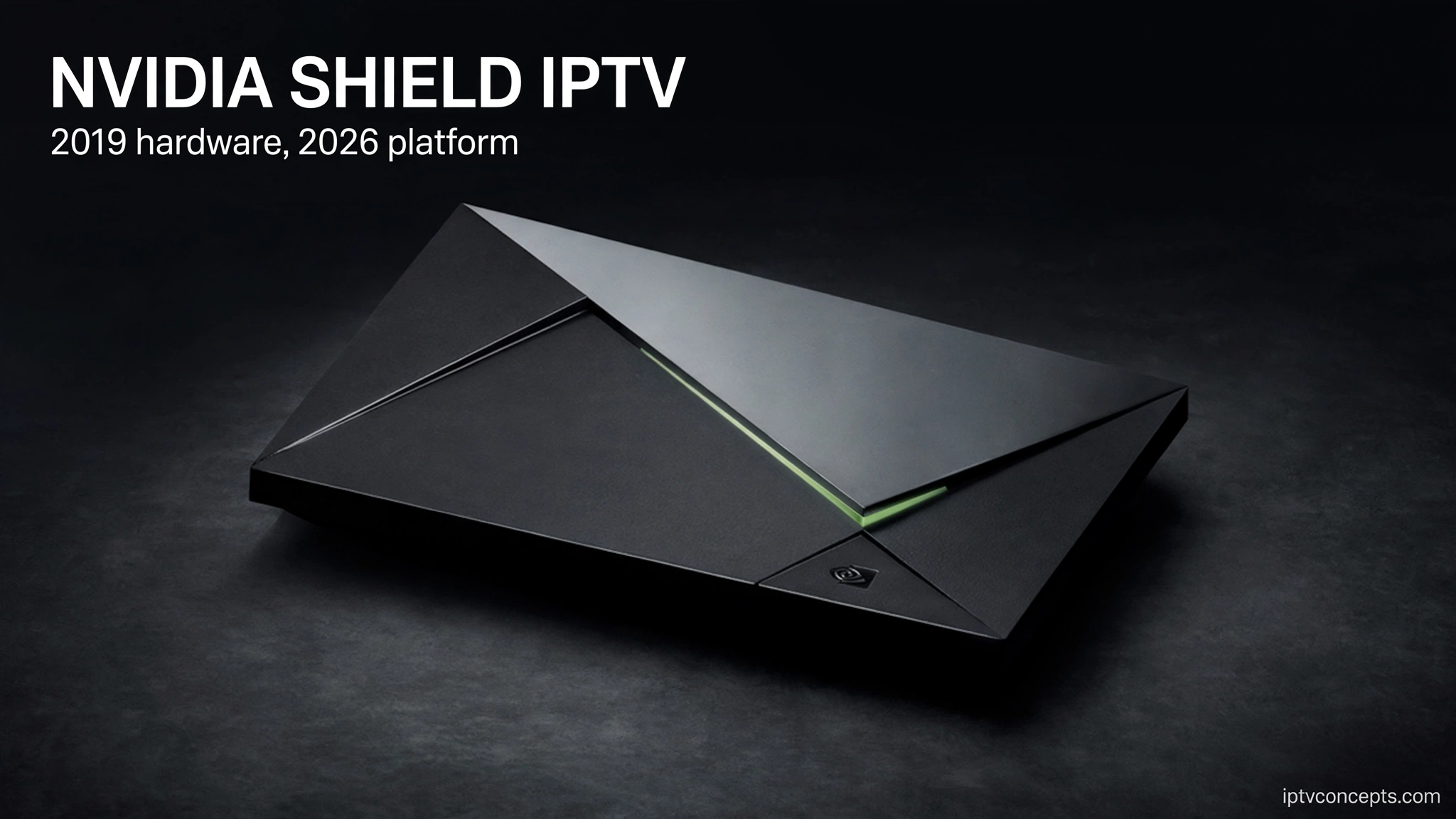
Quick answer: The Shield runs full Android TV, which gives it access to a far broader range of IPTV player apps than closed television platforms allow. NVIDIA released SHIELD Experience 9.2.4 in February 2026, carrying January 2026 security patches, and has not announced an end-of-life date. The 2019 hardware does show its age in codec support and HDMI standards. For IPTV, platform support can matter more than the device’s release year.
Is the NVIDIA Shield Still Good for IPTV in 2026?
The short answer is yes, for a specific kind of buyer — and the reasoning matters more than the verdict.
What Actually Decides Whether a Streaming Box Still Works
A streaming device stops being useful for one of three reasons: the platform stops receiving apps, the operating system stops receiving security patches, or the hardware can no longer decode what you want to watch.
Release year reliably predicts none of those. A device sold last month can sit on a locked platform with a thin app catalogue. A device from 2019 can sit on an open one with a deep catalogue and current patches. What you are actually buying is access, and access is a property of the platform.
That framing is what makes the Shield’s age less decisive than it first appears. It is also why several devices sold new in Canada today are, for IPTV purposes, more constrained than ones released in 2019.
What NVIDIA Confirmed About Support
This is where the internet gets noisy and where verification pays off.
A number of pages currently claim NVIDIA ended Shield support in 2022 or 2023, and at least one describes the product as having moved to “legacy status.” NVIDIA’s own software update page contradicts this: SHIELD Experience 9.2.4 is documented there, and it applies to both the Shield TV and the Shield TV Pro.
The update landed in February 2026. Engadget reported that it carries January 2026 security patches and that NVIDIA’s senior vice president of hardware engineering, Andrew Bell, told Ars Technica the company has no plans to end support any time soon—adding that it had “played with new concepts” for future hardware.
Read that carefully, because it establishes two different things. NVIDIA’s current software record and Bell’s comments both point toward continued support rather than an announced end-of-life date. Neither is a guarantee about 2028. But a device patched four months ago by a company publicly stating it is not walking away is a materially different proposition from one abandoned three years back—which is what several search results will tell you.
Why the NVIDIA Shield Gives IPTV Users More App Flexibility
Here is the practical advantage, and it has grown rather than shrunk as the hardware aged.
Full Android TV and What That Opens Up
The Shield runs Android TV with the Google Play Store, which means access to the broad Android TV application ecosystem—and, importantly, the ability to install Android applications that are not distributed through that store.
For IPTV, that second point is what matters. Many dedicated player apps are not listed in mainstream television app stores, and on an Android TV device the installation route for them exists. Terms used here are defined in our IPTV glossary.
Worth stating precisely: this gives access to a broad app ecosystem, not to every IPTV app in existence. Some players are iOS-only, some are built for particular platforms, and some simply do not have an Android TV build. The Shield widens your options considerably. It does not eliminate the question.
How Closed Platforms Compare
The contrast is what makes the Shield’s position clearer, and each of these is covered in detail elsewhere on this site.
| Platform | IPTV player options | Constraint |
|---|---|---|
| Android TV — Shield | Broad | Few, beyond app availability |
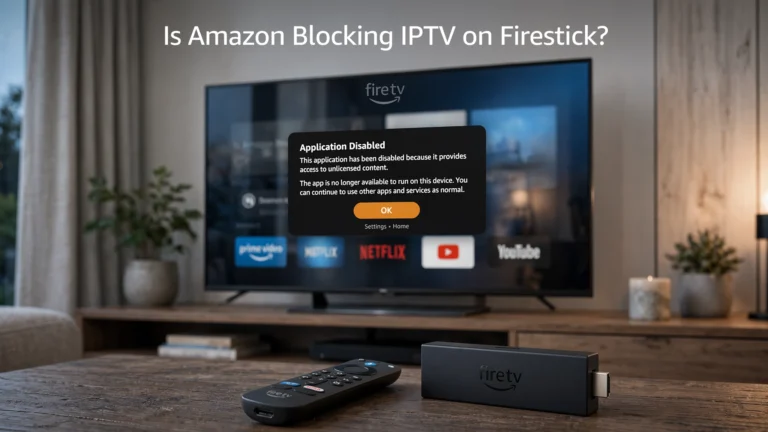
| Fire OS | Broad, with caveats | Amazon began blocking some app installations in 2026 |
| Amazon Vega OS | App Store catalogue only | Not Android-based; no Android app installation |
| Samsung Tizen | Store catalogue only | Not Android; varies by region and model |
| LG webOS | Store catalogue only | Not Android; varies by region and model |
The direction of travel is the point. Amazon’s newer sticks moved to Vega OS and away from Android, while Samsung and LG have always run their own platforms with catalogues that vary by region. A reader who arrived at this article after discovering their television or new streaming stick will not install the player they wanted is, essentially, looking for what the Shield still offers.
Shield TV or Shield TV Pro — What Matters for IPTV?
Two models share the 2019 generation, and the marketing implies the Pro is the serious choice. For IPTV specifically, the gap is narrower than it looks.
| Shield TV | Shield TV Pro | |
|---|---|---|
| Processor | Tegra X1+ | Tegra X1+ |
| RAM | 2 GB | 3 GB |
| Internal storage | 8 GB | 16 GB |
| Storage expansion | microSD | 2 × USB 3.0 |
| Ethernet | Gigabit | Gigabit |
| Form factor | Cylindrical, compact | Flat, set-top |
| Android TV and Play Store | Yes | Yes |
| AI upscaling | Yes | Yes |
Both run the same processor, the same platform, and the same Gigabit Ethernet. Both install the same IPTV players.
The Pro’s extra hardware matters mainly for specific use cases, not because IPTV itself requires a Pro. The additional gigabyte of RAM helps when several apps stay resident. The USB ports matter if you attach external storage or run a media server. Neither is a requirement for watching live channels through a player app.
Where the extra RAM can help is with recording and a sizable channel list—a player holding thousands of channels plus guide data uses memory. If you plan to record heavily or run multiple playlists, the Pro is the safer choice. For a single subscription and live viewing, the standard model does the same job.
IPTV Apps on the NVIDIA Shield
Why App Choice Is the Real Advantage
Player apps differ substantially in interface, guide presentation, channel management, and recording. On a closed platform, you have to accept whatever the catalogue offers. On the shield you choose, and you can change your mind.
TiviMate is the player most commonly associated with Android TV boxes, and our TiviMate review covers what it does and what its paid tier adds. It is one option among several — our comparison of the best IPTV app for Canadian viewers covers the alternatives.
The freedom to switch matters more than any single recommendation. Providers behave differently across players, and a subscription that misbehaves in one app sometimes works cleanly in another. Being able to test that is a real advantage.
Playlists, EPG, and Player Compatibility
Whichever player you install, your provider supplies credentials in one of two formats: an M3U playlist URL or Xtream Codes details consisting of a server address, username, and password. Entering one where the other is expected is a common source of apparent failure. Our IPTV setup guide for Canada covers the entry process.
Program guide data arrives separately as an XMLTV feed, independent of your video streams—which is why the guide can sit empty while channels play normally. That failure has its own set of causes, covered in IPTV EPG not working. Canadian viewers should pay particular attention to the time-zone offset, since the country spans six of them.
NVIDIA Shield IPTV Performance: Where 2019 Hardware Still Holds Up
Network and Playback
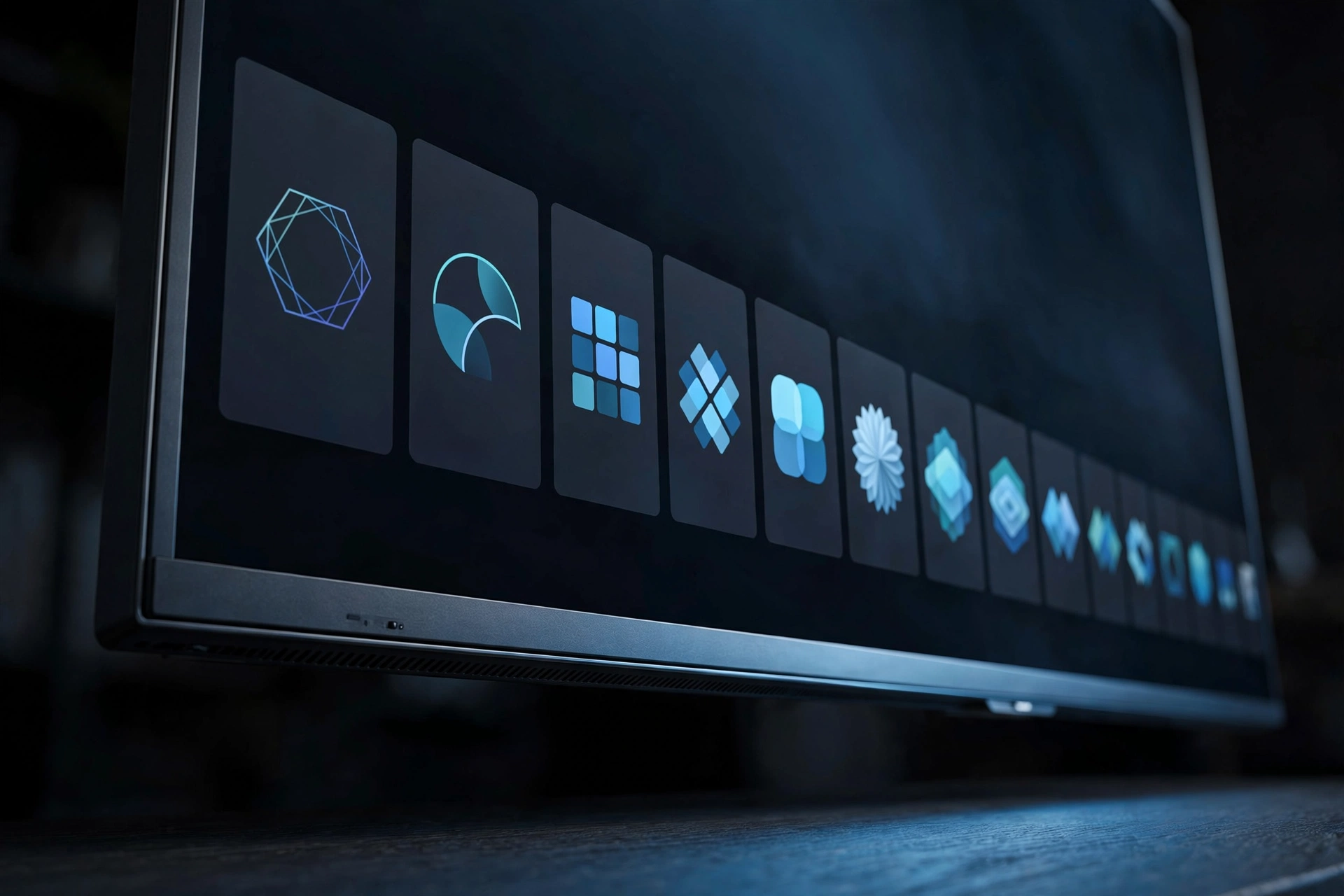
Both models include Gigabit Ethernet, and for IPTV this is the specification that earns its keep. A wired connection removes the variable that causes most playback complaints—wireless interference and congestion between the router and the device. Several newer streaming sticks are wireless-only, which means their best case is still worse than a wired Shield’s ordinary case.
The Tegra X1+ handles HEVC decoding and Dolby Vision, which covers what current IPTV streams generally use. Whether any particular stream plays smoothly depends far more on the provider, the content delivery network, and your ISP than on the box—a chain covered in how IPTV actually works.
Where the 2019 Hardware Shows Its Age
Age matters—just not necessarily in the way a casual buyer expects.
Codec support has moved on. The Shield’s decoding covers H.264 and HEVC. Newer codecs, AV1 among them, are not part of this generation’s hardware decoding. For IPTV as delivered today, this issue is rarely a limitation, since providers overwhelmingly use HEVC or H.264. It becomes one if delivery formats shift.
HDMI 2.0b, not 2.1. Sufficient for 4K streaming. Relevant only if you were expecting features tied to the newer standard.
Interface responsiveness. Owners and reviewers have noted that menu animations feel slower than on current premium boxes — a 2019 processor driving a 2026 launcher. This affects navigating the home screen rather than playback quality, and most IPTV viewers spend their time inside a player app rather than on the launcher.
And a signal worth reading: Bell’s comments about future hardware mentioned support for codecs including AV1 and HDR10+, which is a reasonably clear indication of where NVIDIA sees the current generation’s limits. That is honest information about what you are buying.
None of these prevent IPTV from working well. All of them are reasons to go in with accurate expectations rather than assuming a 2019 device matches a 2026 one on every axis.
NVIDIA Shield vs. Fire Stick for IPTV
This is a use-case decision rather than a specification contest, and the honest framing is short.
Choose the Shield when platform flexibility is the priority. You want a wide choice of player apps, wired Ethernet, and a platform that has not narrowed. You are running IPTV daily, and the device is doing real work.
Choose a Fire TV device when cost and simplicity matter more. Fire OS models remain Android-based and install IPTV players at a fraction of the price. The caveat is which model you buy—Amazon’s newer sticks run Vega OS and do not support Android app installation, covered in Firestick IPTV setup.
The Shield is not the obvious recommendation for a casual viewer. It is the obvious recommendation for someone who has already hit a limitation on cheaper hardware and does not want to hit another.
Is There a 2026 NVIDIA Shield TV Pro?
Search results include listings and articles describing a “2026 NVIDIA Shield TV Pro” with newer silicon and 8K capability. This claim deserves skepticism.
NVIDIA has not announced a 2026 Shield hardware generation in the official product information we reviewed. Andrew Bell’s January 2026 comments describe exploring concepts and outline what a future refresh might support — which is a statement about internal work, not an announced, available product.
Treat any listing describing 2026 Shield hardware with specifications beyond the documented 2019 models as unverified. The current generation remains the 2019 Shield TV and Shield TV Pro, both running the Tegra X1+ and receiving the same software updates.
Who Should Buy the NVIDIA Shield for IPTV — and Who Shouldn’t?
Best Fit: Users Who Need App Flexibility
The Shield makes sense if you run IPTV daily and want a specific player rather than whatever a catalogue offers; if you have already been blocked by a platform limitation on a smart TV or a newer stick; if wired Ethernet matters to your setup; or if the device is doing double duty for local media, Plex, or emulation.
Buyers in this group are typically replacing something that disappointed them, and they know precisely which limitation they are paying to avoid.
Not the Best Fit: Buyers Who Want Basic Streaming
If your use is a single subscription in a player that is available everywhere, and you are not attached to a particular app, cheaper hardware does the same job. A Fire OS Firestick or an inexpensive Android TV box installs the same players for considerably less.
The Shield is also the wrong purchase if you are expecting current-generation hardware. It is a 2019 platform that has aged well, not a new device.
Legal note: this guide covers device capability only. IPTV Concepts does not sell, recommend, or endorse any IPTV subscription service. A streaming device is neutral hardware; whether viewing is lawful depends on the content source and its distribution rights. See what Canadian law says about IPTV and our disclaimer.
Bottom Line
The NVIDIA Shield IPTV question comes down to one trade, stated plainly: you are buying 2019 hardware on a platform that has stayed open at a time when several newer devices have closed.
Three things worth carrying away:
- Support is current, whatever search results claim. SHIELD Experience 9.2.4 arrived in February 2026 with January security patches, and NVIDIA has stated it is not ending support soon.
- The advantage is app flexibility, not raw speed. Full Android TV gives access to a broad player ecosystem that closed platforms do not match.
- The age is real and worth knowing. Codec support and HDMI standards belong to 2019. For IPTV as delivered today, that rarely bites, so go in informed.
For IPTV, platform support can matter more than the device’s release year — and that is the entire case for a seven-year-old box in 2026.
Comparing hardware more broadly? Our best IPTV device in Canada guide covers the field. Anything not answered here is welcome through our contact page.
Sources
- NVIDIA — SHIELD Software Update — SHIELD Experience 9.2.4 release notes. Accessed August 2026
- Engadget — NVIDIA updates Shield TV after pledging further support — February 2026, including Andrew Bell’s comments to Ars Technica. Accessed August 2026
- 9to5Google — Shield TV update following promise of continued support—security patch level and changelog. Accessed August 2026
- Android Central — NVIDIA Shield TV vs Shield TV Pro — model differences. Accessed August 2026