
Look up the IPTV meaning, and you get a clear answer in four words: Internet Protocol Television. Then you notice the same three letters describing your neighbour’s Bell Fibe box, a ten-dollar subscription advertised on a forum, and Netflix itself on some sites.
Those cannot all be the same product, and the resulting confusion is not your fault. The term is used at more than one level, and knowing which one someone means makes the difference between understanding what you are buying and guessing.
IPTV Meaning — The Short Answer
IPTV stands for Internet Protocol Television — television services delivered using Internet Protocol networks. The term carries two established uses. Canadian broadcasting authorities apply it as a category within their broadcasting-distribution classification, covering services like Bell Fibe and Telus Optik TV, while internet and commercial usage applies it far more broadly to almost any IP-delivered television. Both uses are current; they simply have different scopes.
Important distinction: The CRTC uses IPTV as a category within its broadcasting-distribution classification. The broader internet and commercial market uses it to describe television delivered over IP networks in general. Neither usage is invented—they operate at different levels, and most confusion around the term comes from mixing them.
Reviewed for accuracy: August 2026 — sources: CRTC, Broadcasting Act.
For the technology itself and what you need to use it, our guide to what IPTV is covers the relevant information. This page is about the word.
Breaking Down the Three Letters
IP — Internet Protocol. The addressing and routeing system on which the entire internet runs. Data is split into packets, each labelled with a destination address, and reassembled at the other end. You have met the same three letters elsewhere: An IP address is your device’s identifier on a network, and VoIP is voice carried the same way. IPTV applies the principle to television.
TV — Television. Video programming, including live channels and on-demand libraries.
Put together, the term describes television associated with Internet Protocol delivery. That is the whole of the literal definition, and it is where most explanations stop. The important point is what the acronym does not tell you: which regulatory or commercial category a given service belongs to. That gap is precisely why the term causes so much confusion in Canada.
The Canadian Regulator Uses a Narrower Definition

Here is what almost no page explaining this term mentions: Canada’s broadcasting regulator publishes its own classification, and it is considerably narrower than everyday usage.
In the CRTC’s Broadcasting Distribution Sector – CMR (2013–2024), broadcasting distribution undertakings are grouped into three types: cable, Internet Protocol Television, and national direct-to-home satellite providers. The report states that IPTV refers to services such as Bell Fibe and Telus Optik TV and excludes internet-based services such as Netflix, Crave, and Club illico.
| Within the CRTC’s IPTV classification | Classified separately |
|---|---|
| Bell Fibe TV | Netflix |
| Telus Optik TV | Crave |
| Comparable IP-delivered subscription television from broadcasting distributors | Club right away |
Show Image One term, two levels of usage – and the gap between them explains most of the confusion.
Read that table carefully, because it is deceptively simple to draw the wrong conclusion from it. Netflix appears on the right because it uses IP technology. It appears there because the classification concerns how television services are distributed and categorised within Canada’s broadcasting framework, not simply whether IP is involved. Both columns use internet protocol. They occupy different regulatory categories.
This discrepancy is also why Canadian coverage of IPTV can read strangely against international coverage. A Canadian regulatory document and an American marketing page can use the same word for measurably different sets of services, and both are using their terminology consistently.
Managed IPTV vs Open-Internet Streaming
Set the regulatory classification aside for a moment and look at how these services actually reach you, because there is a practical difference underneath — one worth understanding on its terms, separate from how any regulator categorises it.
| Telco IPTV | Open-internet streaming | |
|---|---|---|
| Example | Bell Fibe TV, Telus Optik TV | Netflix, Crave |
| Typical delivery environment | Provider-managed television service | Open internet |
| Typical network relationship | More control over service delivery | Delivery depends on the service and your internet connection |
| Access | Often tied to provider service and equipment | Usually an app on an internet-connected device |
| Content emphasis | Live linear channels plus on-demand | Predominantly on-demand |
The practical distinction is between “uses IP” and “does not use IP.” Both do. What differs is the delivery environment and how much of it the service itself governs. A television service delivered within a provider’s own managed environment sits in a different position from one that reaches you across the open internet, where the connection between you and the service is not the service’s to control. How IPTV actually works traces that path stage by stage.
Keep the two ideas separate in your head. The delivery difference above is a technical observation. The CRTC’s classification is a regulatory one. They point in broadly similar directions, but one is not the stated reason for the other.
IPTV vs OTT — Why the Terms Get Confused

‘OTT’ – over-the-top – describes video services delivered over the internet rather than through a managed television distribution service. The “over the top” image is of content riding on top of an internet connection; the service does not operate itself.
So why do the terms blur? Because from where you sit, the experience is close to identical. Both arrive over your internet connection. Both play on a smart TV, a phone, or a streaming stick. Both charge monthly. Both offer live and on-demand content. When two things look the same to the person using them, the words describing them drift together — and marketing accelerates that drift, since “IPTV” sounds more technical and more established than “streaming app”.
Show Image: Why do two different terms end up describing the same experience on your sofa?
The distinction is still useful, as it describes how a service reaches the viewer — even when the viewing experience looks almost identical. A content provider delivering over the internet does not control the whole path between its servers and your screen. Both terms are defined alongside the rest in our IPTV glossary.
Why the Term Got Wider
No single moment widened the meaning. The pattern is easy enough to follow.
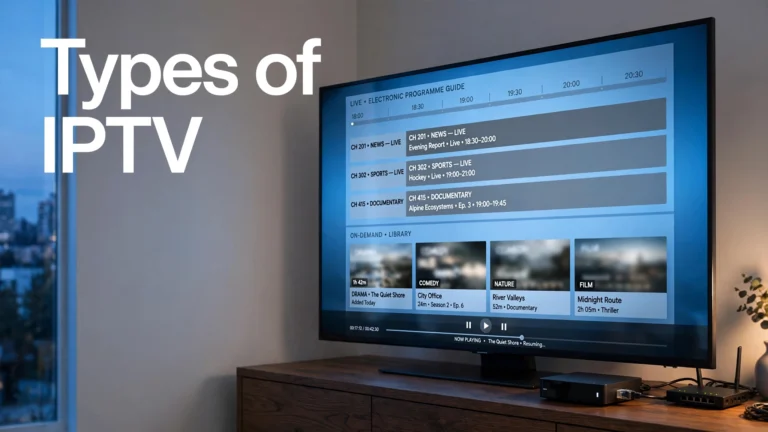
IP-based television delivery became ordinary. Telcos launched managed IPTV services, and separately the internet filled with video services of every description — subscription libraries, free ad-supported channels, live sports platforms, and independent operators selling channel packages directly.
For a viewer, all of these are television programmes arriving via an internet connection. A viewer on the couch cannot see the distinctions that matter to a regulator. Over time, people began using the term more broadly online, especially for services that deliver television and video over an internet connection.
That is language behaving normally. Words widen when the category they name widens. The only consequence for you is this: the word alone no longer tells you what kind of service you are looking at.
What It Means When a Provider Says “IPTV”
Which brings us to the practical question — what should you understand when a service markets itself as IPTV?
Treat the label as a description of the delivery method, not as a credential. It tells you the video arrives over an internet connection. It tells you nothing about who holds rights to the content, whether the operator is identifiable, what happens when a stream fails at 8pm during a playoff game, or whether anyone answers your email.
The questions worth asking are about the service rather than the term. Who operates it, and can you find out? Where does the programming come from? What is offered when something breaks? A CRTC-classified IPTV service from a Canadian broadcasting distributor and a subscription sold anonymously through a messaging app can both accurately be called ‘IPTV’ in the broader sense, but they are not comparable propositions.
On cost. Both paid and free IP-delivered television exist. Telco services are typically bundled with internet and priced accordingly, while third-party subscriptions advertise far lower monthly figures. A wide price gap between two things sharing a label is usually a signal that they are not the same category of service.
On legality. The label itself does not determine whether a service is legal. What matters is the service being provided and how the content is obtained and distributed — this is covered in detail by what Canadian law says about IPTV. See also our disclaimer.
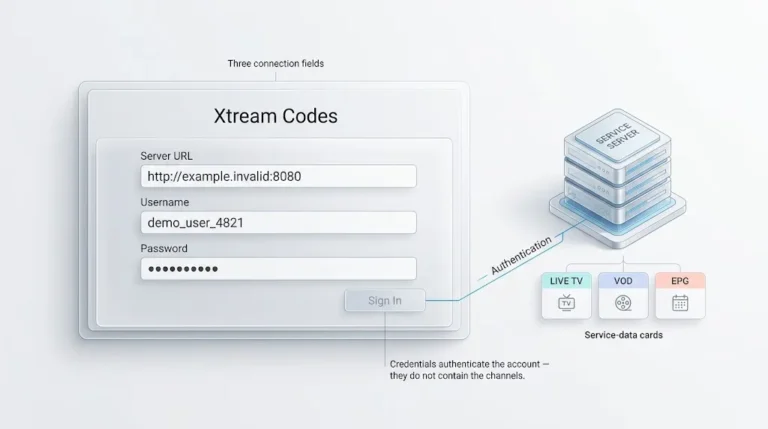
One more piece of vocabulary worth separating: the service and the app are different things. A player application is software that reads your credentials and displays channels. It is not itself an IPTV service, though people often discuss the two as if they were the same purchase. Our guide to the best IPTV app for Canadian viewers covers that side.
Bottom Line
The IPTV meaning question has a short answer and a useful one, and they are not the same length.
Short: Internet Protocol Television — television delivered over IP networks.
Useful: the term operates at two levels in Canada. The CRTC applies it as a category within its broadcasting-distribution classification, covering services such as Bell Fibe and Telus Optik TV, treating Netflix, Crave, and Club Illico separately. Commercial and internet usage applies it far more broadly. Both are current, and neither is a misuse — but they describe different sets of services, and a page using one can coexist with a page using the other.
Netflix sitting outside the CRTC’s IPTV classification does not mean Netflix avoids IP technology. It means Canada’s broadcasting framework, built on the categories set out in the Broadcasting Act, classifies it elsewhere.
The practical takeaway is small and worth keeping: the word “IPTV” on a sales page tells you very little about the service by itself. Quality, legality, reliability, and accountability are properties of the service — not of the label attached to it. Evaluate what is actually being offered.
New to the topic? Start here; it lays out every part of it in order. Questions we have not answered are welcome through our contact page.
Sources
- CRTC — Broadcasting Distribution Sector, Communications Monitoring Report (2013–2024) — classification of BDU types and the stated scope of IPTV. Updated 28 August 2025; accessed August 2026.
- Broadcasting Act — definition of broadcasting undertaking — statutory basis for distribution, programming and online undertakings. Accessed August 2026.
- CRTC — Broadcasting Distribution Regulations (SOR/97-555) — regulatory framework for distribution undertakings. Accessed August 2026.