
Search for the types of IPTV and you will find at least four different answers. One source lists three. Another lists six. A third source mixes live television with subscription pricing, as though they belong on the same list. None of them is exactly wrong, and that is the problem.
There is no single universal list. The term is used to describe several different aspects of a service—what you watch, how it reaches your screen, and how access is paid for. These are separate questions, and a service answers each one at the same time. Once the axes are separated, the contradictions between sources disappear, and — more usefully for anyone in Canada — it becomes possible to see which of them has anything to do with whether a service is lawful. If you are still figuring out what IPTV is, please start there and then come back.
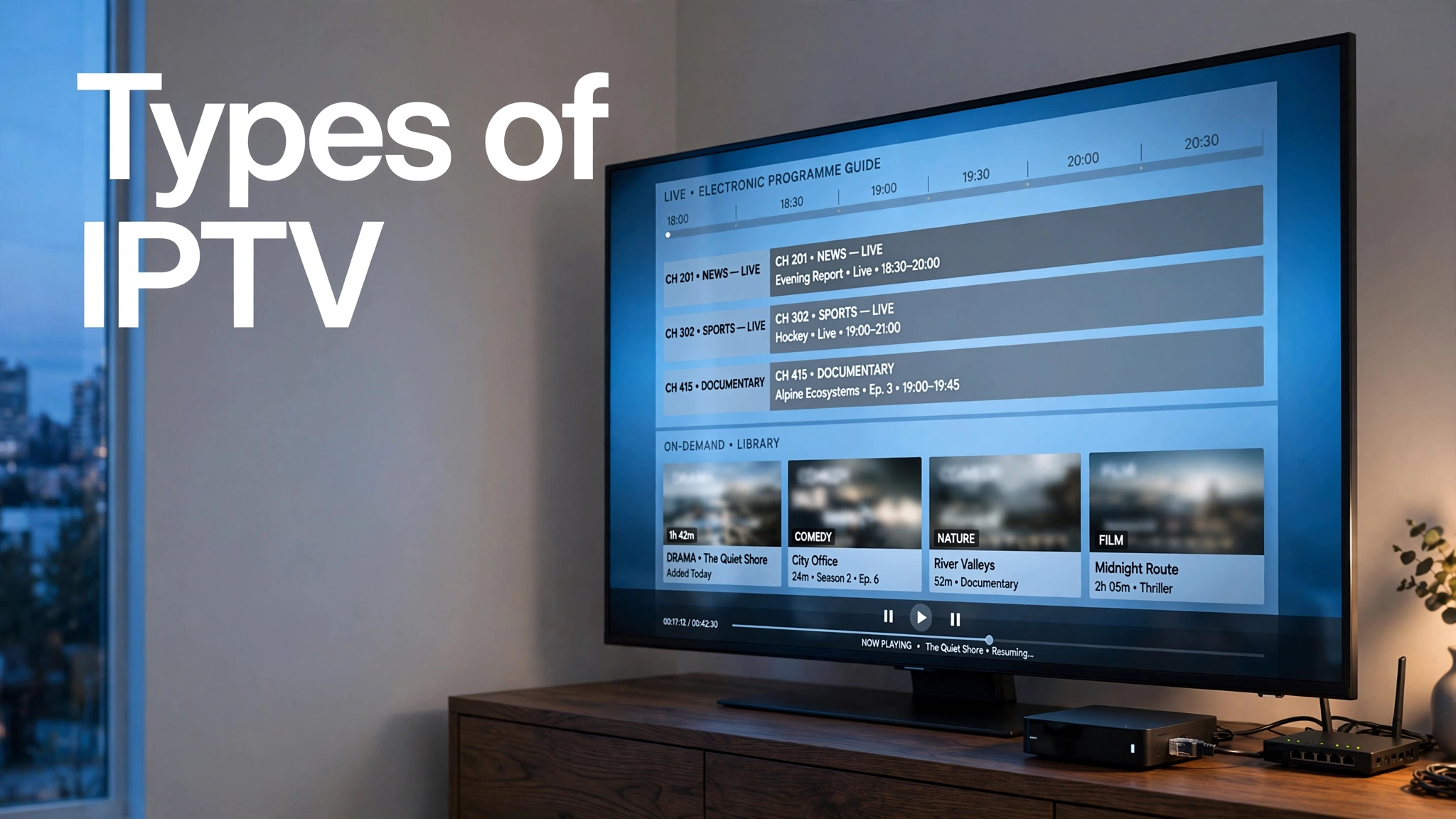
Quick answer: There is no single list of IPTV types. IPTV services are classified on three separate axes: content type (live, VOD, catch-up, and start-over), delivery model (managed or internet-based), and service model (subscription, transactional, advertising-supported, or free access). A service has an answer to all three at once. None of these factors determine whether the service is lawful; that depends on the rights and authorization behind the content and service, not on its technical architecture.
What “Types of IPTV” Actually Means
The industry itself has inherited this confusion. Broadcast engineers classify by content. Network operators classify by delivery path. Platform businesses are classified by revenue model. All three groups say “types of IPTV” and mean something different.
The International Telecommunication Union’s Recommendation ITU-T Y.1901 defines services such as video on demand in functional terms — what the end user can select and control. That is useful here because it describes service capabilities rather than giving readers a single universal list of “IPTV types.”
So here are three useful ways to classify an IPTV service:
- Content type — what you are watching
- Delivery model — how it reaches you
- Service and payment model — how you get access
The first two describe technical or delivery characteristics. The third describes the commercial model. And none of the three determines whether a service is lawful, which is covered further down. Unfamiliar terms along the way are collected in the IPTV glossary.
Content Types: What You Can Watch
This is the axis most articles mean by “types,” and it matters most day to day.
Live IPTV
Live IPTV carries linear channels in real time, with programs following a scheduled broadcast sequence. The defining characteristic is that you do not choose when a program starts. A news broadcast at 6 p.m. begins at 6 p.m.
Live services are the reason IPTV needs an electronic program guide at all. Without a schedule, a list of live channels is unreadable. The mechanics of how a live stream travels from the broadcaster to your screen are covered in how IPTV actually works.
Video on Demand (VOD)
VOD is a catalogue. Content sits in storage, and playback begins when you select it. Nothing is tied to a broadcast schedule, and the same title is equally available at 3 p.m. or 3 a.m.
The functional definition matters more than the label: with VOD you control the temporal order of playback—starting, pausing, skipping forward and back. That control is what separates it from a live feed, not the content type itself. A film and a football match can both be VOD.
Catch-Up TV
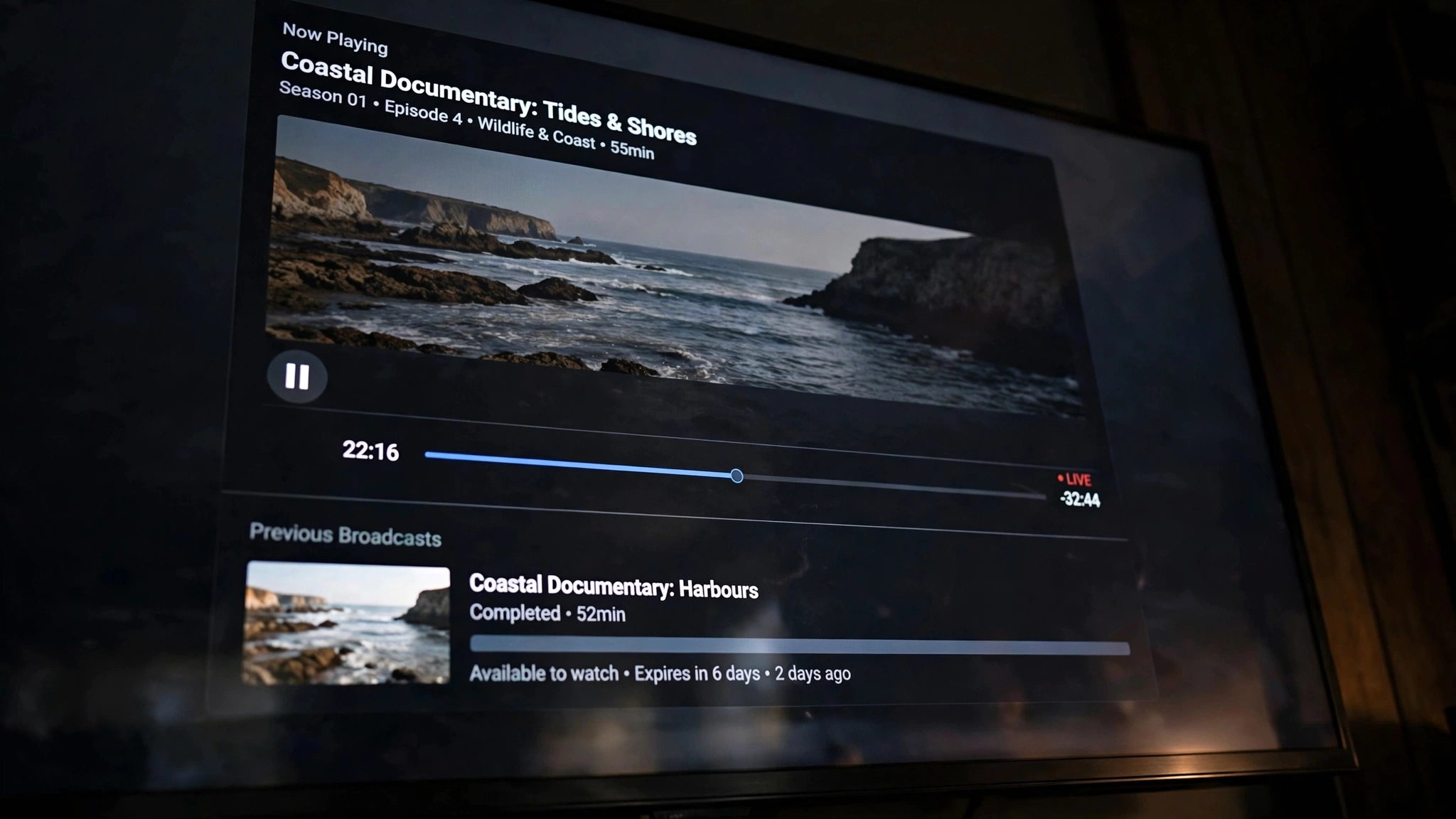
Catch-up TV lets you watch a program after it has already been broadcast, within a defined availability window. The window is the key. A broadcaster might make last night’s episode available for seven days, or thirty, or until the end of the season.
This is where catch-up and VOD blur and where most explanations give up. The distinction is not the technology—both stream stored content on demand. The distinction is that catch-up content originated as a scheduled broadcast and is normally offered for a defined catch-up window, while a VOD catalogue entry is offered as on-demand content under its own availability terms.
Start-Over TV
Start-Over restarts a program that is still within its current broadcast—you join a match twenty minutes late and jump back to kickoff while the live feed continues elsewhere.
Catch-Up and Start-Over are routinely treated as the same feature. They are not. Catch-Up applies after a broadcast has ended; Start-Over applies during one. A service can offer either without the other, and terminology varies considerably between providers—some brand Start-Over as “restart,” others fold it into a catch-up menu. Check what the feature does rather than what it is called.
Where These Categories Overlap
A single service usually offers several of these at once, and a single program can move between them: live during broadcast, available via Start-Over throughout, then Catch-Up for a week, then possibly a permanent VOD entry. The categories describe access modes, not separate products.
Delivery Models: How IPTV Reaches You
The second axis is the path from source to screen, and it has real consequences for playback quality.
Managed IPTV
In a managed IPTV service, the provider controls significant parts of the network and delivery path rather than relying entirely on the public internet. That control can provide the operator more ability to manage capacity, traffic treatment, and quality than a service delivered entirely over the public internet.
In Canada, the television services offered by major telecom providers over their own broadband—Bell Fibe TV, Rogers Ignite TV, and Telus Optik TV among them—are the familiar examples. These are examples of the model, not its definition: modern delivery architecture is layered, and a managed service may still use CDN components and multiple IP networks along the way.
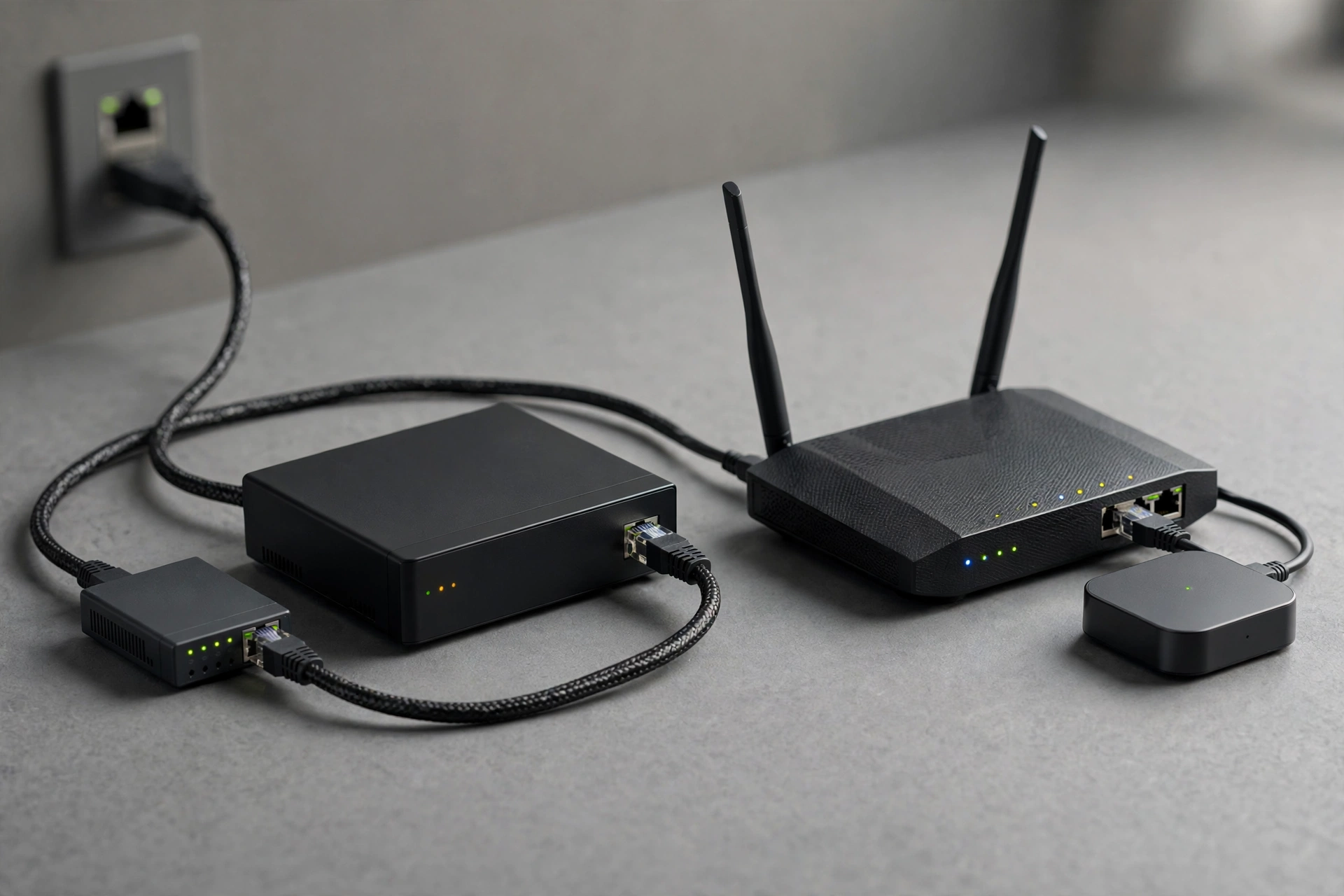
Internet-Based IPTV and OTT
Some IPTV services are delivered over internet connections without the provider controlling the entire delivery path. OTT describes a related but not identical concept: content delivered over the public internet outside a traditional managed television network. The terms overlap, but they are not interchangeable in every context.
This distinction matters because the delivery path does not determine legality. An OTT service can be entirely lawful, and using the public internet says nothing by itself about whether a service is entitled to distribute its content.
Why Delivery Method Matters
It is relevant for buffering. A managed path can hold quality steady under load; an internet-based path competes with everything else on the network, which is why adaptive bitrate switching exists and why picture quality shifts mid-stream. Many playback problems can be traced to this axis, particularly when the delivery path is competing for capacity on the public internet—though the source, the server, the app, the device, and the home network all produce their own failures. The complete IPTV fix guide for Canada works through the symptoms.
Service and Payment Models: How You Access It
The third axis is commercial. These are business models rather than technical categories, which is precisely why listing them alongside “live TV” causes confusion.
| Model | How you pay | What you get |
|---|---|---|
| SVOD | Recurring fee | Catalogue access |
| TVOD | Per title | Rental or purchase |
| AVOD | Advertising | On-demand catalogue, free at point of use |
| FAST | Advertising | Linear-style channels, free at point of use |
FAST is a service and business model rather than a technical type of IPTV, though it is frequently listed as one.
“Free IPTV”: What the Label Actually Means
Search volume for free IPTV is substantial, and the label covers two entirely different situations. The first is licensed and ad-funded—AVOD catalogues and FAST channels, where the operator holds distribution rights and advertising pays for them. The second is redistribution of content without authorization, offered at no charge.
Both get called “free IPTV.” Only one of them is a service model. The other is a rights problem wearing a pricing label.
Why Monthly Price Isn’t a Type
“How much does IPTV cost monthly” is among the most common Canadian searches on this topic, and it does not classify anything. Price reflects catalogue size, rights costs, and market position. Two services with identical technical architecture can differ substantially in price, and an unusually low price is a signal about rights rather than efficiency.
Are All IPTV Types Legal in Canada?
None of the three axes above settles this, which is the single most important thing to take from the classification.
Legal Content vs. Unauthorized Redistribution
Whether an IPTV service is lawful depends on what it distributes and whether it has the rights or authorization required to distribute that content—not on which technical type of IPTV it uses. A managed service redistributing channels without authorization is unlawful. An OTT service with full distribution rights is lawful. The architecture is irrelevant to the question.
CRTC Registration Is Not a Legality Check
This issue deserves care, because the inference is tempting and wrong. Following the Online Streaming Act, the CRTC established a registration regime for online undertakings. Its guidance on registration for online streaming services sets out three criteria that together trigger the duty to file: operating in Canada, offering broadcasting content, and earning $10 million or more in annual broadcasting revenues. That figure is counted alone or as part of a broadcasting ownership group and covers revenue collected in the Canadian market during the previous broadcast year from both online and licensed broadcasting services.
Look closely at what the exemptions rest on. A service is exempt if it earns less than $10 million in Canadian broadcasting revenues, if it only uploads content to social media, or if its sole purpose is providing video game or audiobook services. Every one of those is a question of scale or purpose. None is a question of whether the service holds the rights to what it carries.
Registration is triggered by a revenue threshold; it is not a legal-status badge. A service can fall below that threshold and therefore never appear on the CRTC’s published list of registered online streaming services. Conversely, appearing on that list does not by itself establish that the service has rights to every piece of content it distributes.
Separately, the CRTC’s own broadcasting-distribution reporting treats IPTV as one distribution category alongside cable and satellite, covering services such as Bell Fibe and Telus Optik. That is a category within a distribution classification — not a definition of the word for every purpose, and not a statement about lawfulness.
What Canadian law says about IPTV use is covered in Is IPTV legal in Canada?, and questions about what an internet provider can observe are addressed in Can IPTV be detected? Site-blocking orders in Canada have targeted specific unauthorized services and addresses rather than IPTV as a technology—the classification is not the relevant variable. This site’s disclaimer sets out the limits of what any of its content represents.
How to Classify Any IPTV Service
Four questions settle what any service actually is.
| Question | Classification |
|---|---|
| What can I watch? | Live · VOD · Catch-Up · Start-Over |
| How does it reach me? | Managed · Internet-based / OTT |
| How do I access it? | Subscription · Transactional · Advertising-supported · Free access |
| Is it lawful? | Depends on content rights and authorization—not on any answer above |
Conclusion
The types of IPTV are not one list but three, and running a service through all three tells you what it is. Key points to carry forward:
- Live, VOD, Catch-Up, and Start-Over are access modes, not separate products—one programme can pass through all four
- Catch-Up applies after a broadcast ends; Start-Over applies while it is still on air
- “Managed” and “internet-based” describe the delivery path, and that path affects playback quality, not lawfulness
- SVOD, TVOD, AVOD, and FAST are commercial models rather than technical categories
- CRTC registration is triggered by revenue and purpose thresholds—it certifies nothing about content rights
The first three axes describe a service. The fourth — whether it is lawful — is independent of them, and that independence is the whole point. Two services can match on every technical and commercial axis and sit on opposite sides of the law, because the difference lives in rights agreements rather than architecture.
The rest of this section builds on that classification, starting with what IPTV is. For questions about this site’s editorial scope or sources, see the contact page.
Sources
- Recommendation ITU-T Y.1901 — Requirements for the support of IPTV services — International Telecommunication Union. Accessed 19 August 2026.
- Registration for online streaming services—CRTC, modified 1 August 2024. Accessed 19 August 2026.