
Can IPTV be detected? Nearly every page answering that question in Canada is published by someone selling a subscription or a VPN, and both have a reason to shade the answer. One side says you are invisible. The other says you are exposed.
The accurate answer is more specific and more useful than either of the two because detection is not a single thing; the gap between what a network operator can technically observe and what actually follows from it is where the real answer lies.
Quick answer: Yes, IPTV traffic can be detected. Canadian ISPs can see that a connection is carrying a sustained video stream and which server it reaches, through traffic-pattern analysis, packet inspection, DNS queries and address matching. What they generally cannot read is the encrypted video payload itself. Detection on its own carries no automatic consequence — Canadian copyright complaints run through a notice system, and a copyright owner generally needs a court order to obtain a subscriber’s identity from the ISP.
This document was reviewed for technical and legal accuracy in August 2026. Sources checked: Government of Canada, Office of the Privacy Commissioner of Canada, CRTC, Supreme Court of Canada, and Federal Court decisions.
This guide separates four things that most articles blur together: what is technically visible, who can see it, what Canadian law permits, and what has actually happened in the courts. If IPTV is new to you, our guide to what IPTV is covers the groundwork first.
What Your ISP Can Actually See
Every connection leaves two kinds of trace, and confusing them is why this topic produces so much contradictory advice.
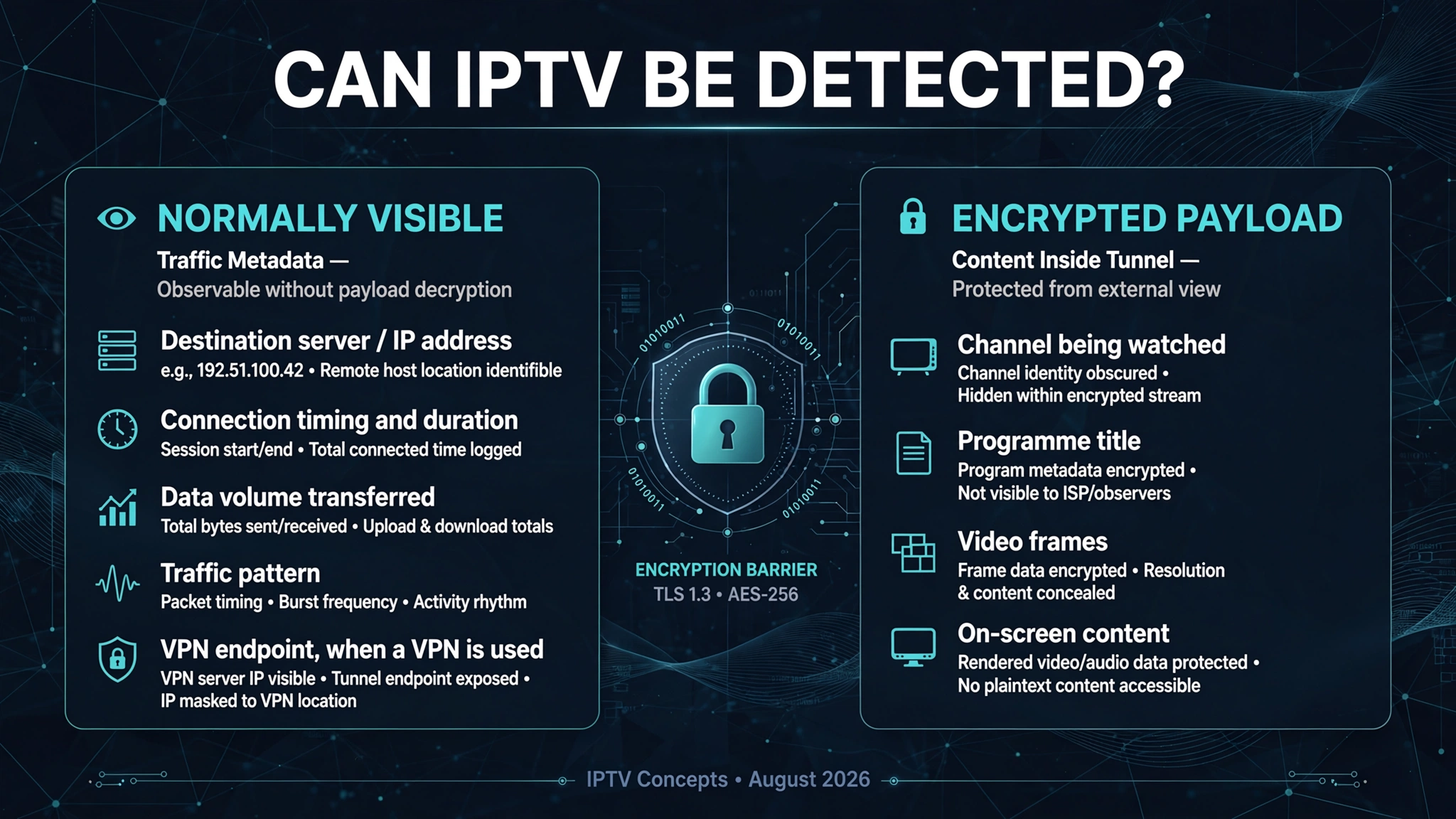
Metadata is routeing information: which server you connected to, when, for how long, and how much data moved. This information is visible to your ISP by necessity rather than by surveillance. A network cannot deliver packets without knowing where to send them.
The content is the video itself. Where the stream travels over an encrypted connection, the payload is not readable in transit. Your ISP can see that 4 GB arrived from a particular address over two hours. Reading which programme those bytes contained is a different problem.
The distinction that matters: Your ISP knowing that you streamed is routine. Your ISP is not reading what you streamed on an encrypted connection.
That gap explains the contradictions. A page claiming your ISP watches what you watch overstates it. A page claiming you are invisible ignores metadata — and metadata is often enough on its own, since a connection pulling continuous video from an address known to distribute unlicensed streams tells a fairly complete story without anyone decrypting anything.
Can IPTV Be Detected? The Four Technical Methods
Detection is not one technique. Four approaches operate at different layers, and each sees something different.
Traffic pattern analysis is the simplest. Live video has a recognisable shape – sustained throughput, steady packet timing, hours of continuous flow rather than the bursts typical of browsing. No content inspection is required. The pattern alone separates streaming from everything else on the line.
Deep packet inspection examines packet headers and structure rather than volume alone and can identify characteristics of the traffic beyond its size. It is widely deployed equipment on large networks. The CRTC’s framework for managing internet traffic allows technical measures to reduce congestion, including slowing down data flows and identifying heavy users, provided the practices are disclosed.
That framework does not, by itself, establish that any particular Canadian ISP uses DPI to identify IPTV traffic specifically. DPI is defined in our IPTV glossary alongside the other terms here.
DNS query logging captures the addresses your device asks to resolve. Before your player can reach a server, it typically asks a DNS resolver to translate the hostname, and unless you have changed resolvers, that lookup goes to your ISP.
Address matching compares the servers you connect to against catalogued addresses. It requires no inspection of your traffic at all — only a list. It is the least sophisticated method and frequently the most conclusive.
Encryption defeats payload inspection. It defeats none of the other three.
Can Bell, Rogers, or Telus See Your IPTV?
At the network level, the basic visibility is broadly similar across these carriers, because the question is about how networks work rather than about any one carrier’s policy.
| Connection metadata | Encrypted video payload | |
|---|---|---|
| Bell | Visible | Generally not readable |
| Rogers | Visible | Generally not readable |
| Telus | Visible | Generally not readable |
| Smaller ISPs and resellers | Visible | Generally not readable |
Read the text correctly: the table describes normal network visibility — what any ISP is technically positioned to observe. It is not a claim about what Bell, Rogers, or Telus currently monitor, log, or act on. Those are separate questions, and their answers are not public.
Canada’s concentration matters here as context rather than accusation. A handful of carriers control most residential broadband, so the technical picture is broadly uniform across the country. That uniformity is why per-ISP claims circulating online — this one throttles, that one does not — should be treated with caution. They are usually anecdote rather than measurement.
The Question Nobody Asks — What Your Provider Sees
Attention is often directed at the ISP, but this is not the best place to start.
Your IPTV service handles authentication and stream requests through its middleware layer. That means it may have access to account details, device identifiers, session times, and which channels were requested — not through surveillance, but because processing those requests is the service. Exactly what gets recorded and retained depends on the provider’s infrastructure and logging practices, which vary and are rarely published.
The privacy position is more complicated than most pages suggest. Under PIPEDA, organisations collecting personal information in the course of commercial activity carry obligations around consent, retention and disclosure — and the law can apply to organisations outside Canada in some circumstances, particularly where there is a real and substantial connection to Canada.
Applicability is one thing; enforcement is another. Exercising a privacy right against an operator with no published address, no identifiable corporate entity, and payment taken in cryptocurrency is difficult in practice regardless of what the law says on paper.
Worth sitting with: A VPN changes what your ISP observes. It changes nothing about the provider whose server you log into with credentials tied to your email and payment method.
Detection Is Not Consequence — How Canadian Law Works
Here is where most competing pages go wrong and where the useful answer lives.
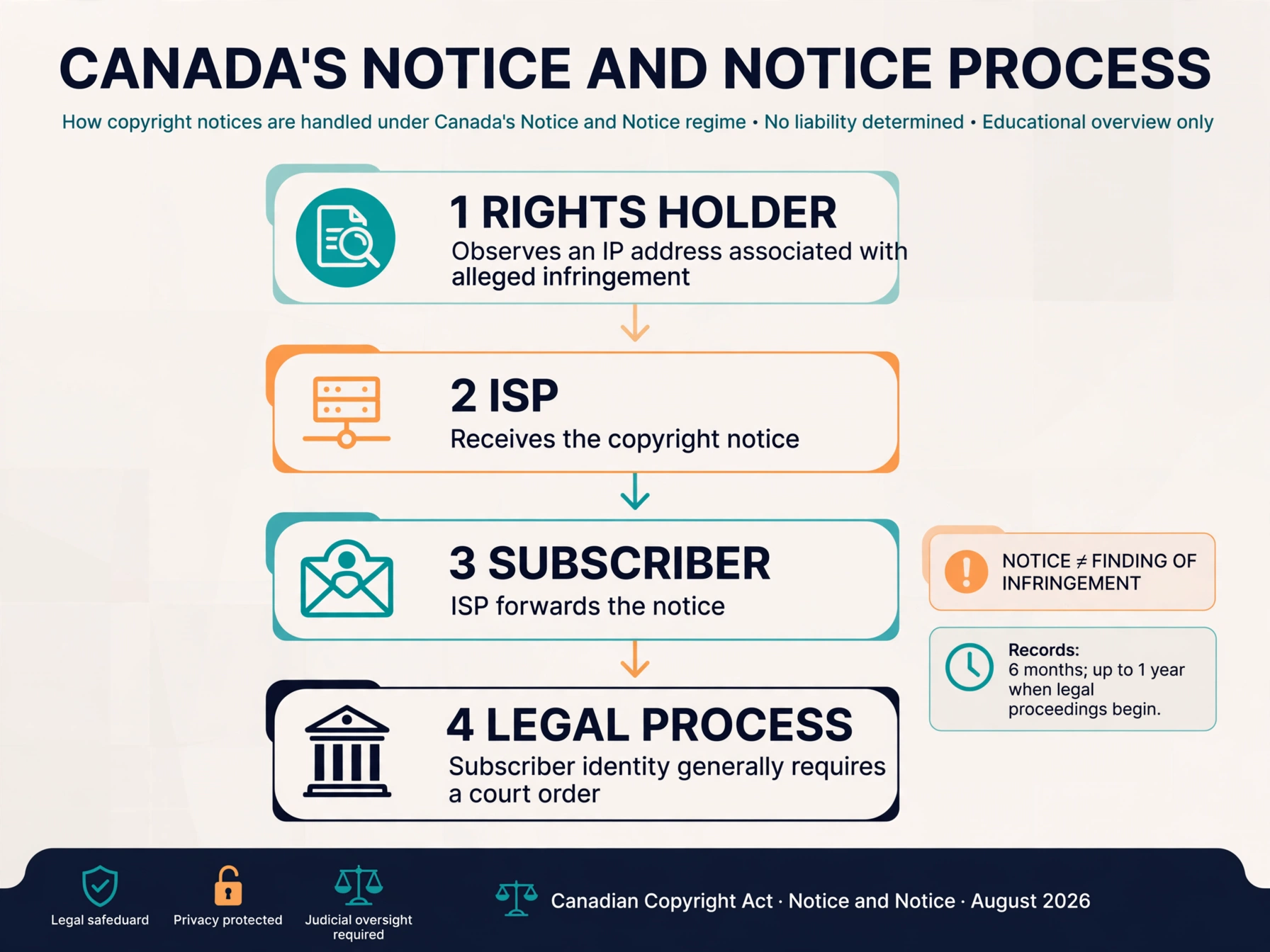
Canada does not operate a system where an ISP detects something and acts on it. Copyright complaints are processed under the Notice and Notice regime in the Copyright Act. A rights holder observing an IP address associated with alleged infringement sends a notice to the ISP that owns the address. The Government of Canada’s Office of Consumer Affairs explains that the ISP must forward the notice to the subscriber and confirm to the rights holder that it has done so.
Three details are consistently misreported.
Receiving a notice does not disclose your identity. An ISP does not normally hand subscriber information to a rights holder simply because it has forwarded a complaint. Subscriber details can be obtained, but only through a court order in appropriate copyright proceedings — the mechanism at issue in Rogers Communications v. Voltage Pictures, where the Supreme Court held that ISPs may recover reasonable costs for identifying a subscriber under such an order and that the notice regime itself does not require ISPs to keep records in a form that makes identification straightforward.
A notice is an allegation, not a finding. A court would have to determine whether infringement occurred. The regime places no obligation on the recipient to respond, to contact anyone, or to pay a settlement demand that a notice might contain.
Retention is bounded. ISPs retain records identifying notified subscribers for six months, extending to one year where legal action begins.
The chain that matters: Detection is not identification, and identification is not a finding of infringement. Each step is a separate threshold with its own requirements.
For the fuller legal picture, see what Canadian law actually says about IPTV and our disclaimer.
What Canada Has Actually Done
Theory aside, Canadian courts have built a specific and evolving record, and almost no page covering this topic reports it accurately.
2019 — the first site-blocking order. In Bell Media Inc. v. GoldTV.biz, the Federal Court ordered eleven ISPs to block the domains and addresses of an unlicensed IPTV service. TekSavvy opposed it; the other named ISPs did not. The order was static — it listed specific sites, and adding more required returning to court.
2021 — upheld on appeal. The Federal Court of Appeal affirmed the order in TekSavvy Solutions Inc. v. Bell Media Inc. Leave to appeal to the Supreme Court was later dismissed.
2022 — blocking becomes dynamic. In Rogers Media Inc. v. John Doe 1, the Federal Court granted an order requiring ISPs to block addresses hosting unauthorised NHL streams in real time during game windows, with sites unblocked after each window closed.
The list updated repeatedly during a single match rather than with a fresh court application. The firms involved in the case have described it as the first dynamic site-blocking order of its kind in North America. A comparable order followed for World Cup broadcasts the same year.
2024 — renewal and expansion. Further Federal Court proceedings continued the approach, with orders covering unauthorised streams of NHL, NBA and Premier League broadcasts.
The pattern is clear enough to state plainly. Canadian site-blocking has moved from naming a handful of sites to following streams as they move, and it is applied seasonally around live sport — which is precisely where unlicensed IPTV demand concentrates.
Two qualifications matter as much as the timeline. These orders were directed at services, sources, and network addresses and required ISPs to block access — they did not themselves impose measures against individual viewers. And separately, the original GoldTV order was discontinued in December 2024 when the rights holders did not seek an extension, though by then the dynamic approach had already superseded it.
What a VPN Changes, and What It Does Not
VPN marketing dominates this topic, so the honest accounting is short.
A VPN does change what your ISP can observe about your destination. Instead of a direct connection to an IPTV server, your ISP generally sees an encrypted connection to a VPN server.
A VPN does not make you invisible. Your ISP can still see that a VPN connection exists, which VPN endpoint you reached, when you connected, and how much data moved. Tunnel traffic has its own recognisable characteristics. “Encrypted” and “unobservable” are not the same word.
A VPN changes nothing about what your provider sees, since you still authenticate with your own credentials. It does not alter the legal status of any content. It does not remove your payment trail. And encryption overhead typically costs some throughput — a real consideration when a 4K stream already needs headroom.
The claim to distrust: “A VPN makes IPTV legal.” It does not. A VPN is a privacy tool. It changes visibility, never permission.
Whether that trade is worth making depends on your situation, and we work through it in “Do I need a VPN for IPTV in Canada?“.
Detection, Throttling, and Telling Them Apart
Many Canadians conclude they have been detected because their stream degrades at 8pm. That conclusion is usually premature.
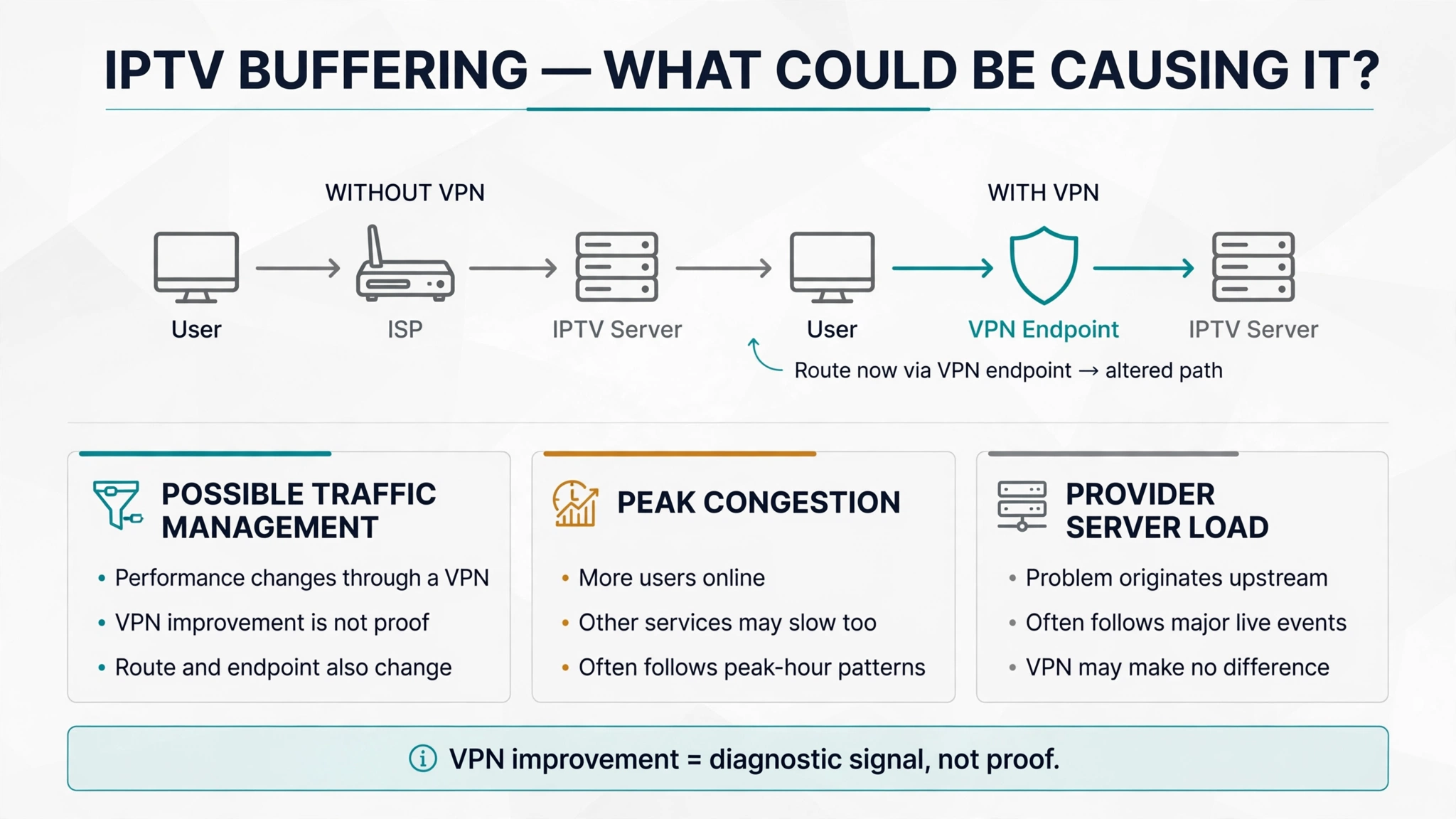
The same symptom has three quite different causes: targeted traffic management, neighbourhood congestion at peak hours, or the provider’s own servers buckling under load. They feel identical and call for opposite responses.
The common test is to compare performance with and without a VPN — and the common mistake is to treat the result as proof. If performance improves substantially through a VPN, that is a useful diagnostic signal, not evidence that your ISP was throttling. A VPN also changes your route, your peering path, the congestion points you pass through, and which server endpoint you reach. Any of those can account for the difference on its own.
A more reliable approach is comparison across several dimensions: run tests at different times of day and, where possible, across different networks or endpoints. Congestion follows a clock and affects everything on the line. A provider-side problem follows their event schedule and persists regardless of what you do at your end.
Our complete IPTV fix guide for Canada works through the full diagnostic sequence, and how IPTV actually works explains why the same symptom can originate at several different points in the delivery chain.

Bottom Line
Can IPTV be detected in Canada? Yes – but the question people really mean to ask is what happens next, and that answer is less dramatic than either the subscription sellers or the VPN affiliates suggest.
Three things worth keeping:
- Metadata is visible; the payload usually is not. Your ISP can see that a stream is running and where it comes from. On an encrypted connection, it cannot see what you are watching.
- Your provider may see more than your ISP does. Middleware handles your login and your channel requests, so account, device and session information can be available to it — and a VPN does nothing about that.
- Detection and consequence are separate systems. Copyright complaints run through notice and notice; identification requires a court order, and Canadian site-blocking orders have targeted services and addresses rather than viewers.
If you are still weighing your options, start here; it lays out the whole topic in order. If you have questions about anything not covered here, please reach out through our contact page — we read every message.
Back to the parent guide: what IPTV is and what Canadian viewers need to know.
Sources
- Government of Canada, Office of Consumer Affairs — Notices to Canadian Internet Subscribers — accessed August 2026
- Rogers Communications Inc. v. Voltage Pictures LLC, 2018 SCC 38
- Bell Media Inc. et al v. GoldTV.biz et al., 2019 FC 1432; affirmed TekSavvy Solutions Inc. v. Bell Media Inc., 2021 FCA 100
- Rogers Media Inc. v. John Doe 1, 2022 FC 775 — dynamic site-blocking order involving unauthorised NHL streams; subsequent proceedings 2024 FC 1082
- Office of the Privacy Commissioner of Canada — PIPEDA — accessed August 2026
- CRTC — Internet Traffic Management Practices — accessed August 2026