
Search results on this question are close to useless, and the reason is specific rather than general. Two entirely separate things happened to Amazon’s streaming devices, roughly a year apart, and almost every page treats them as one event. Ask about Amazon blocking IPTV on Firestick and you get either a panic headline or a workaround guide, when the accurate answer is that one change is an enforcement program aimed at particular applications and the other is a new operating system that never ran Android software to begin with. Which one affects you depends entirely on which device is plugged into your television. If you are still deciding what to buy, our guide to IPTV devices in Canada covers the wider field.
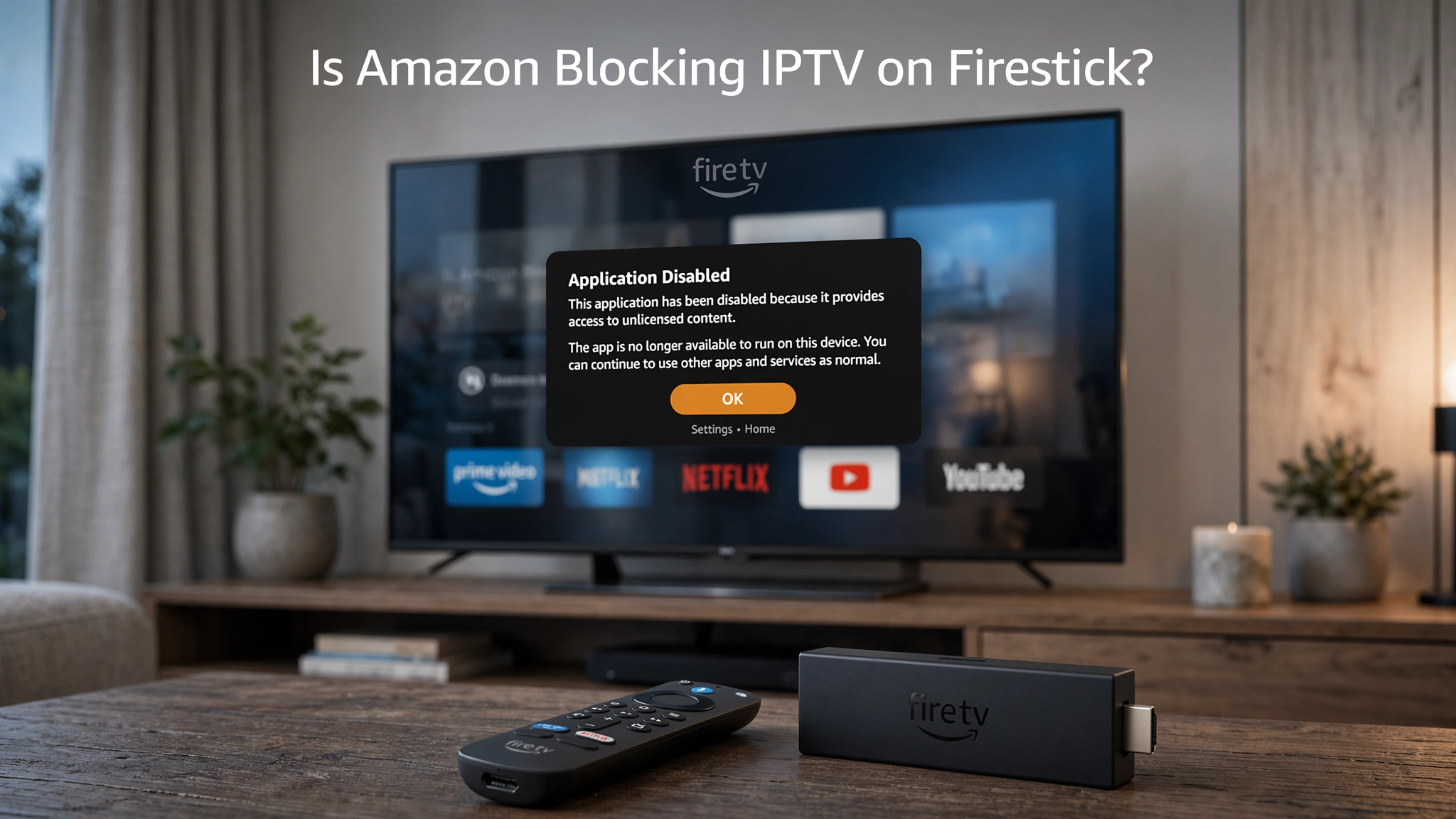
Quick answer: Neither change is accurately described as Amazon blocking IPTV. Amazon runs an enforcement program that disables specific apps identified as providing access to unlicensed content on Fire OS devices. Separately, its newest sticks run Vega OS, which is not Android-based and does not install Android apps at all. One targets applications; the other is a platform difference.
Is Amazon Blocking IPTV on Firestick? The Short Answer
No, not as a category.
There is no switch at Amazon labelled “IPTV” that has been flipped. What exists is an enforcement program that identifies individual applications and disables them and a separate hardware transition that changed what kind of software newer sticks can run.
The published descriptions do not define IPTV players as a category to be disabled; they describe enforcement against apps identified as providing access to unlicensed content. Terms used throughout this article are defined plainly in our IPTV glossary.
That distinction is not pedantry. It determines whether the answer to your situation is “check which model you own,” “check which app you installed,” or “neither of these applies to you.”
Two Changes, Constantly Confused
Here is the sequence, kept apart.
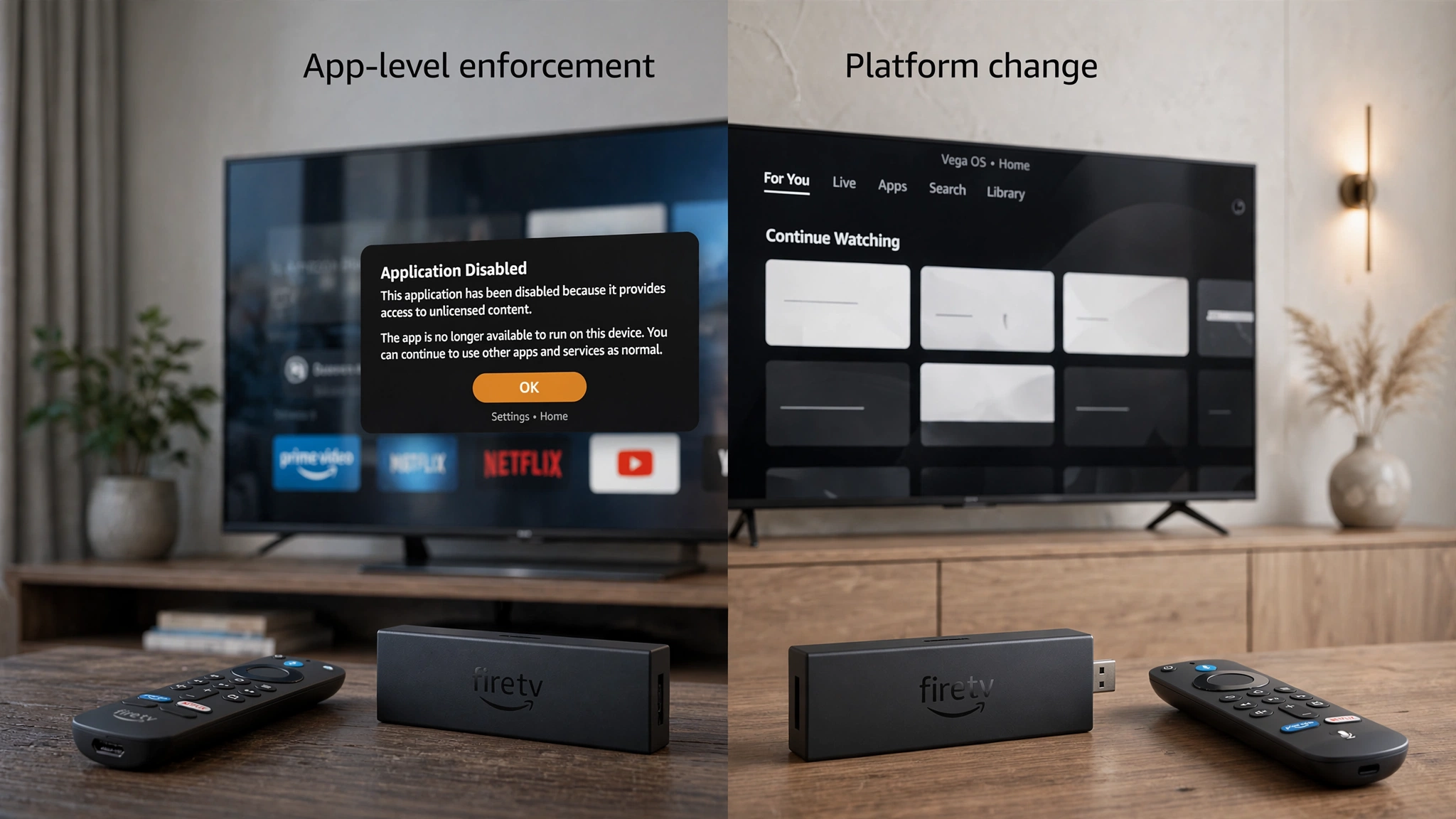
Change One—An App-Level Enforcement Programme
In late 2025, Amazon confirmed it would begin disabling applications identified as providing access to pirated content, including those installed from outside its own store. As BGR reported at the time, the statement covered apps identified as providing access to pirated content, including those installed from outside the Appstore, and named no specific applications.
The identification does not happen at Amazon alone. It works through an arrangement with the Alliance for Creativity and Entertainment, an anti-piracy coalition, under what is generally called a trusted notifier program.
The program acts on applications present on affected Fire TV devices. That Fire OS remains Android-based and continues to run and install Android applications is a separate fact about the platform rather than a description of what the program targets. The capability to install from outside the store has not itself been removed; individual applications are disabled after installation.
Change Two — A New Operating System
Separately, Amazon moved its newest streaming sticks from Fire OS, which is Android-based, to Vega OS, which is not.
Vega does not run Android application packages. This is not enforcement and involves no list, no notifier, and no identification of anything. Android software simply does not apply to a platform that is not Android.
Anyone describing this as Amazon blocking IPTV has misread a platform difference as a policy.
Why Mixing Them Up Leads to Wrong Decisions
The practical damage is real. Several widely circulated pages recommend a VPN as a response — and a VPN cannot address either change. Enforcement operates on the device, against an application already installed on it; a VPN changes the route your traffic takes to the internet, which is a different layer entirely. Nothing about a network path alters what software a Vega device can run.
Other pages tell readers to avoid Fire Sticks altogether, which throws out the Fire OS models the enforcement programme leaves fully capable. Others treat all recent sticks as identical, which is exactly the mistake that leads to buying a Vega device expecting Android behaviour.
| Enforcement programme | Vega OS | |
|---|---|---|
| What it is | Specific apps disabled after identification | A different operating system |
| What it targets | Individual applications | Nothing: It targets nobody |
| Devices affected | Android-based Fire OS devices | Newest sticks only |
| Can a VPN change it | No:rerouting traffic does not re-enable a locally disabled app | No:it is not a network question |
| What it does not do | Disable IPTV players as a category | Enforce anything |
What the Enforcement Programme Actually Does
How Apps Are Identified
Applications are flagged through the trusted notifier arrangement rather than by any automatic judgement about what kind of app something is. A player that connects to a licensed service and a player that connects to an unlicensed one are, architecturally, the same kind of software, which is why the criterion is the content an app provides access to, not its category.
What You See on the Device
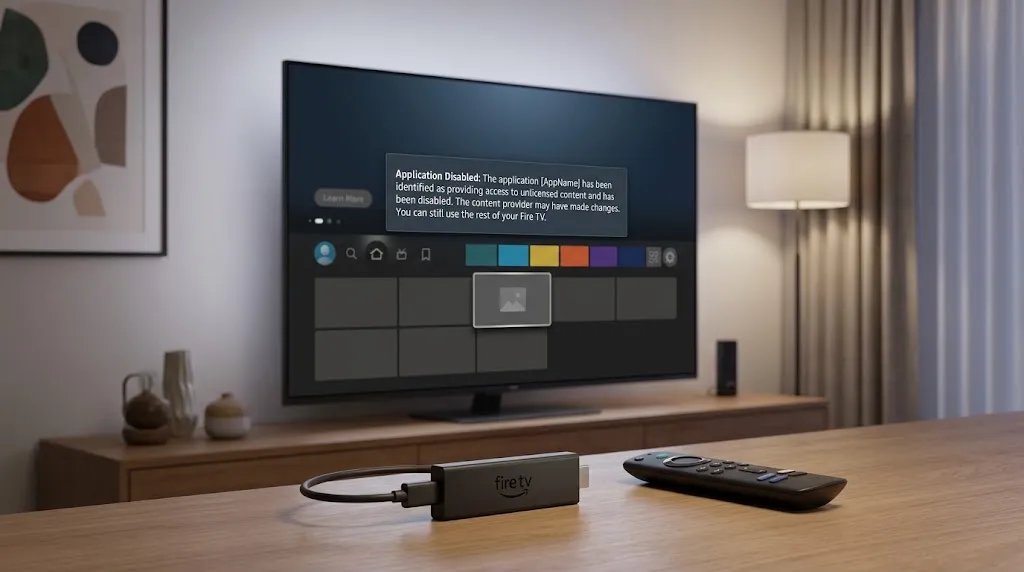
The process is staged rather than sudden. AFTVnews reported that users are notified first, with the app disabled after a period has passed. Amazon’s own support material describes informing customers when an app is identified as providing access to unlicensed content and offering the option to remove it.
So the visible symptom is a notice naming an application—not a general failure of streaming and not a device that stops working.
Why a VPN Does Not Change This
This deserves stating on its own, because it is the most repeated bad advice on the topic.
The action happens on the device, to software already installed on it. An app may, of course, make network connections of its own—that is not the point. The point is that changing the route those connections take does not re-enable an application the platform has disabled locally. Advice to install a VPN to restore a disabled app misdescribes where the mechanism operates. Whether a VPN is worth using for entirely separate reasons is covered in our guide to whether IPTV can be detected.
What Vega OS Changes
Why Android Packages Do Not Apply
Fire OS is built on Android, so Android applications run on it, and Android installation methods apply to it. Vega OS is not built on Android, so neither is true.
An Android player app is not blocked on Vega. It is simply not software that platform runs in the way a Windows program is not software a Mac runs. Nothing is being denied.
Which Devices Run Which System
There is also a direction of travel worth knowing before you spend anything. 9to5Google reported in April 2026 that the newest stick was Amazon’s second Vega device and that future Fire TV Sticks are expected to follow the same path. If that holds, the Fire OS models on sale now are the last of their kind, which changes how you weigh a purchase today.
The practical consequence: apps come from the Amazon store on a Vega device, and what is available there is what you get. Whether the player you want is present depends on whether its developer has built and published a Vega version. Our comparison of the best IPTV apps for Canadian viewers covers which players exist on which platforms.
How to Tell Which Firestick You Own
This is the part almost no guide provides, and it is the only part that resolves the question for an individual reader.
Two Devices, One Name
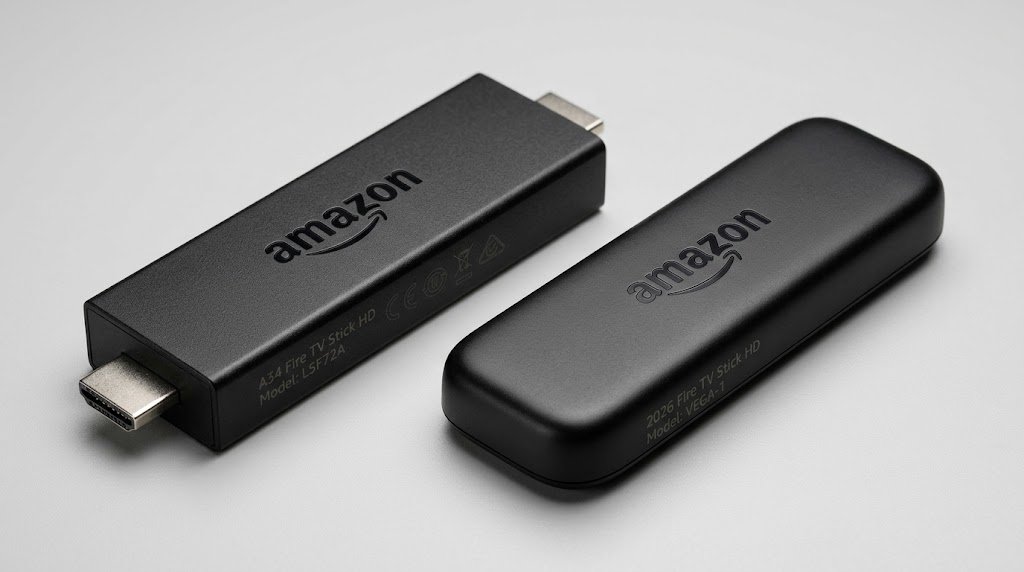
Amazon has sold two different products called Fire TV Stick HD. The 2024 model runs Fire OS. The 2026 model runs Vega. Same name, different platforms, opposite answers to the question this article is about.
Technical reporting from AFTVnews describes the two as differing in Wi-Fi generation, corner shape, and surface markings: the Fire OS version has Wi-Fi 5, squared corners, and no “Fire TV” text on the stick itself, while the newer Vega version does not match that description. These are reported observations rather than a published Amazon comparison, so treat them as a first check rather than proof.
The same reporting places the Fire TV Stick 4K Select, introduced in 2025, on Vega, and describes the remaining 4K models and the Fire TV Cube as running Fire OS. As a rule of thumb, it offers a simpler signal: a 4K stick with “Select” in the name runs Vega.
Checking Before You Buy
For a device you already own, the device settings will report the system version, and the physical markings above settle the Fire TV Stick HD ambiguity.
For a purchase, the caution is straightforward: a listing showing the product name is not enough, because two products share one. Check the release year and the operating system in the specifications before ordering, particularly on marketplace listings where older and newer stock sit side by side. If you have chosen a Fire OS model, our Firestick IPTV setup guide covers the process from there.
Where Canada Stands
Here the honest answer is narrower than most pages suggest.
The enforcement program was described as beginning in the United States and certain other markets, and reporting indicates it later reached the United Kingdom. We found no published confirmation of when, or whether, the program applies to devices in Canada.
We are not going to infer a Canadian rollout from an American or British one. Amazon has not published a country-by-country schedule that we could verify, and a date invented to look authoritative would be worth nothing to you.
What is not in question is Vega OS, which is a property of the hardware and applies wherever the device is sold.
On the legal side — a common follow-up question — none of this is a statement about lawfulness. A player app is neutral software; whether any given service is lawful depends on that service’s content rights and authorization, which we cover in whether IPTV is legal in Canada. See also our disclaimer.
What This Means for the Device You Choose
Three situations, three different answers.
You own a Fire OS device, and everything works. Nothing here requires action. The enforcement program targets identified applications, not the platform and not IPTV as a category.
You own a Fire OS device and saw a notice naming an app. That is the enforcement program, and it concerned that specific application. It is not a device fault and not something a network tool addresses.
You own or are considering a Vega device. This is a platform question with no enforcement component. Your app choices are what the Amazon store offers for that platform, so check for the player you want before buying rather than after.
The wider point for anyone shopping: the operating system now matters more than the model name on Amazon’s own devices, which was not true two years ago.
Conclusion
Is Amazon blocking IPTV on Firestick? Not as a category—and the accurate picture is two separate changes that get told as one story. Key points to carry forward:
- Amazon runs an enforcement programme that disables individual applications identified as providing access to unlicensed content, on Android-based Fire OS devices
- Vega OS is a platform change, not a policy—Android software does not apply to a platform that is not Android
- A VPN addresses neither, because both operate on the device rather than across the network
- Two different products are called Fire TV Stick HD; Wi-Fi generation, corner shape, and surface printing tell them apart
- 4K Select and the 2026 Fire TV Stick HD run Vega; 4K Max, 4K Plus, 4K, Fire TV Cube, and the 2024 HD run Fire OS
- We found no published confirmation that the enforcement programme applies in Canada, and we are not assuming one
If you notice any inaccuracies or changes, please let us know through the contact page—your feedback is welcome, and we read every message. For the broader hardware picture, return to our guide to IPTV devices in Canada.
Sources
- Why Amazon Fire TV is blocking streaming apps: BGR, reporting Amazon’s statement on apps identified as providing access to pirated content. Accessed 26 August 2026.
- Amazon to start blocking sideloaded piracy apps on Fire TVs: AFTVnews, reporting the staged notify-then-disable process. Accessed 26 August 2026.
- Which Fire TVs run Fire OS and which run Vega OS: AFTVnews, reporting model-by-model platform differences and the physical markings on the two Fire TV Stick HD versions. Accessed 26 August 2026.
- Amazon will ditch Android on future Fire TV Sticks: 9to5Google, April 2026, reporting the platform direction for future sticks. Accessed 26 August 2026.