
By Liam Tremblay — IPTV Explained
Ask whether IPTV is legal in Canada, and you will usually find one of two extremes: academic legal explanations with little practical guidance or IPTV sellers claiming everything is perfectly legal. The reality sits somewhere in between.
This guide separates three things that usually get blended together: what the technology is, what Canadian law prohibits, and what enforcement actually looks like on the ground in 2026.
Quick Answer
IPTV technology is completely legal in Canada. Bell Fibe TV, Rogers Ignite TV, and Telus Optik TV all deliver television over IP — they are IPTV services. What Canadian law prohibits is the distribution of copyrighted programming without authorization from the rights holders. Legal responsibility falls primarily on the operator of an unlicensed service, not the person watching it. Whether an IPTV service is legal depends on licensing, not on the technology, app, or device used to access it.

What IPTV Actually Is Under Canadian Law
IPTV stands for Internet Protocol Television. It is a delivery method — television content sent over an internet connection rather than through coaxial cable, satellite, or an over-the-air antenna. In legal and technical terms it is a methodology for moving television signals across IP networks, nothing more.
Canadian law does not regulate delivery methods. It regulates who may distribute programming and under what conditions. Two statutes govern these activities:
The Copyright Act protects the rights of content creators and broadcasters and prohibits communicating protected works to the public without authorization.
The Broadcasting Act sets licensing requirements for entities transmitting programming in Canada. The CRTC—the Canadian Radio-television and Telecommunications Commission—is the regulator that administers it, issuing licenses and setting exemption criteria for broadcasting undertakings. Its governing statutes and regulations are published on the CRTC’s acts and regulations page.
Technology ≠ Legality
IPTV = a delivery method
Licensing = the legal question
Canadian law regulates the second, not the first.
Neither statute mentions IPTV as a category to be permitted or banned. This is the single most important thing to understand before going further. If you want to understand the technical details first, our guide to IPTV explains how the delivery chain works, and the IPTV glossary defines the terms used throughout this article.
Is IPTV legal in Canada? The Licensing Line
One line determines legality, and it has nothing to do with price, app choice, or device.
Does the provider hold distribution rights for the content it transmits?
| Factor | Legal significance |
|---|---|
| Uses IPTV technology | None |
| Runs on a Fire TV Stick or Android box | None |
| Uses IPTV Smarters, TiviMate, or any player app | None |
| Priced below cable | None on its own |
| Holds distribution rights for its content | Determines legality |
If the provider holds the rights, the service is lawful. Canada’s major carriers are the clearest examples — they operate as licensed broadcasting distribution undertakings (the CRTC’s term for a licensed television distributor), pay carriage fees, meet Canadian content obligations, and hold agreements with the rights holders whose channels they carry.
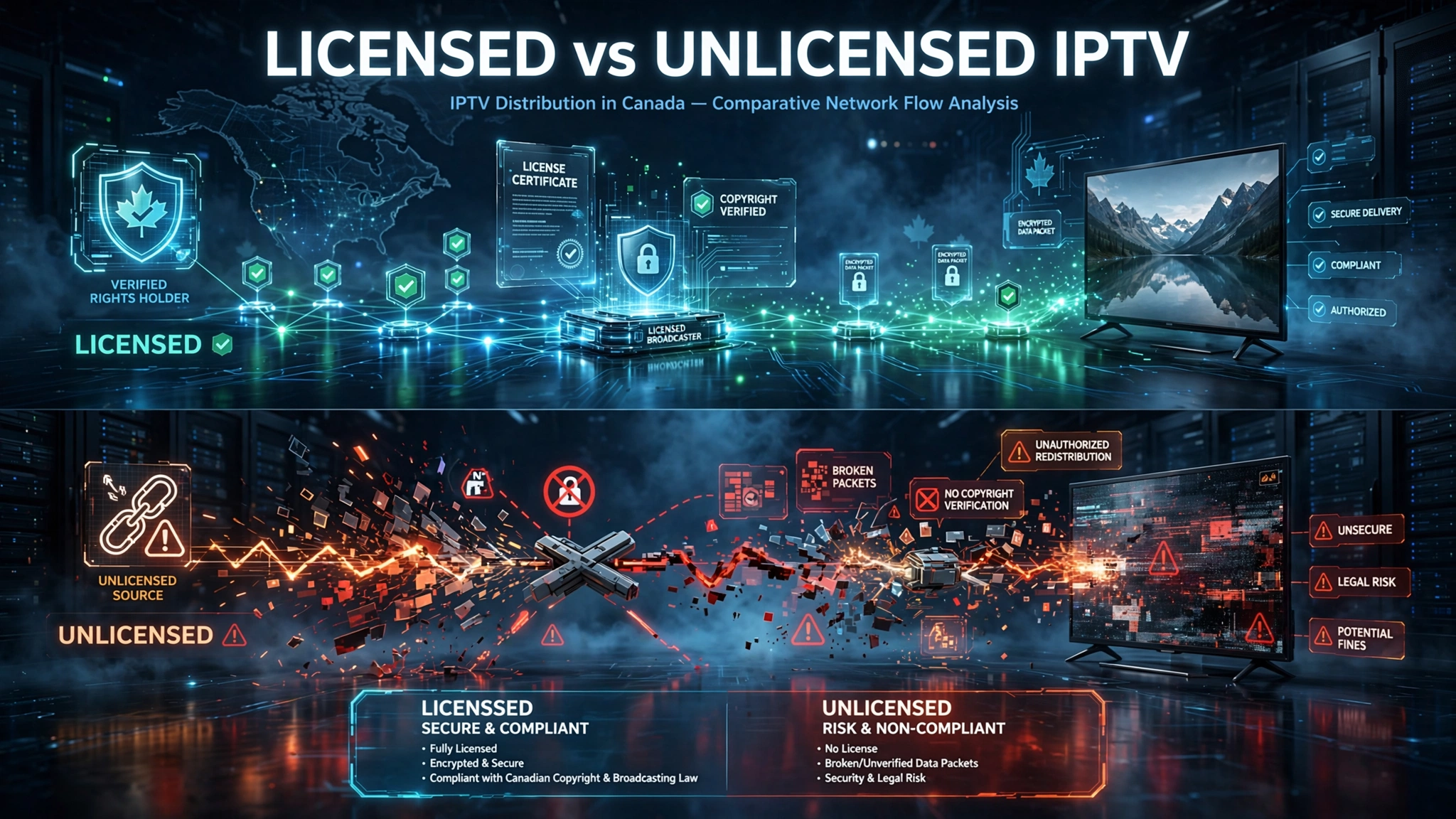
If it does not, the service is distributing copyrighted programming without permission. That is copyright infringement under Canadian law regardless of how the service describes itself, where its servers sit, or how polished its interface looks.
Services in the second category tend to share recognizable characteristics: a flat monthly fee far below what licensing thousands of channels would cost, channel counts spanning multiple countries and premium sports tiers at once, no corporate identity or registered business address, and payment methods that avoid conventional processors. None of these is illegal in itself. Together, they describe a service that cannot plausibly hold the rights it claims to distribute.
Is Watching IPTV Illegal, or Is Selling It the Bigger Legal Risk?
This issue is where most confusion sits, and the distinction matters more than any other point in this article.
In practice, Canadian copyright enforcement has overwhelmingly focused on operators, resellers, and distributors rather than individual viewers. The reported cases follow a consistent pattern—Bell Canada v. iTVBox.net, Bell Canada v. MtlFreeTV.com, Warner Bros. v. White (Beast IPTV), and Bell Canada v. L3D Distributing. Every defendant was running or supplying a service.
The reason is partly principled and partly economic. An individual non-commercial infringer is an expensive target and a small recovery: litigation costs typically exceed the maximum statutory damages available. Rights holders concentrate on large-scale operators, streaming site operators, and repeat infringers who ignore multiple notices.
Criminal exposure runs in the same direction. The Copyright Act’s criminal offences turn on knowingly selling, renting, distributing for trade, or possessing infringing copies for those purposes—commercial conduct, not viewing. Where they apply, penalties reach a fine of up to $1,000,000 and imprisonment for up to five years on indictment, or $25,000 and six months on summary conviction. Those provisions describe a business, not a household.
This is not the same as saying viewing carries no legal exposure. It means the exposure is civil rather than criminal, capped rather than open-ended, and rarely pursued. Selling or reselling access is a materially different position with materially different consequences.
What Canadian Copyright Law Says About Penalties
Here Canadian law diverges sharply from American law, and the difference is routinely misrepresented.
The Government of Canada states directly that U.S. copyright fines and penalties do not apply in Canada and that statutory damages for non-commercial infringement do not exceed $5,000.
| Canada | United States | |
|---|---|---|
| Non-commercial infringement | $100 to $5,000 in total, covering all works in a single proceeding | Up to $150,000 per work |
| Commercial infringement | $500 to $20,000 per work | Substantially higher, with no equivalent cap |
| Criminal (commercial conduct) | Up to $1,000,000 and 5 years | Varies by offence |
Two details make the Canadian civil figure smaller than it first appears.
It is a total, not a per-work amount. For individuals infringing for personal, non-commercial purposes, statutory damages are capped at $5,000 for all infringements in a single proceeding, regardless of how many works are involved. Under U.S. law, the same conduct could theoretically be assessed per work.
The floor is low. Courts may award as little as $100 in total for private-use infringement, and Canadian courts have generally reserved the highest scales for the most extreme cases, keeping aggregate awards proportionate to actual harm.
Commercial infringement is a different exposure entirely. The non-commercial cap protects no one running a piracy operation or distributing content for profit. The consolidated statute is published on the Government of Canada’s Justice Laws website.
What Changed in July 2026? Canada’s Latest IPTV Court Order

If you read a guide on this topic published before July 2026, its enforcement section is out of date. This is the part almost no other page currently covering this question includes.
Why This Matters
Many guides still discuss T-743-24, the multi-sport blocking order.
That order expired on 19 July 2026.
The current framework is T-1127-26, in force until 3 July 2028.
A new blocking order took effect on 3 July 2026. Justice Richard Southcott signed it in Ottawa under docket T-1127-26, targeting 13 named operators running unauthorized IPTV services and open web piracy sites. None of the operators appeared in court. The applicants included Rogers, Disney, Netflix, Paramount, Universal, and Warner Bros., and eight providers — among them Bell, Telus, TekSavvy, and Videotron — are required to carry it out for two years.
Two things make it different from earlier orders.
First, its scope. It is the first Canadian blocking order to cover both IPTV subscription services and public streaming sites in a single proceeding and requires ISPs to block an initial list of 18 domains and subdomains.
Second, its mechanism. Previous rulings locked onto a fixed list of domains, so a service that moved to a new address sent rights holders back to a judge. Under this order, applicants can file an amended schedule adding domains or IP addresses, and if no provider objects within the window the court set, those additions take effect without a hearing. A rights holder adding a new site must file an affidavit confirming the service meets the order’s conditions — that its sole or primary purpose is unauthorized distribution, that it operates similarly to an IPTV or open-web piracy service, and that it is accessible within Canada.
Meanwhile, the sports order many guides still cite has expired. The multi-sport dynamic blocking order under Federal Court File T-743-24 was issued on 9 July 2024 and amended several times; its final amendment on 8 April 2026 extended expiry to 19 July 2026, after the end of the FIFA World Cup. Any article referencing it as the current framework is describing an order no longer in force.
The July 2026 order is scheduled to expire on 3 July 2028 unless the court extends or changes it. It does not affect legal streaming services and does not automatically apply to every internet connection in Canada.
Are Canadian ISPs Blocking IPTV?

Yes — but not in the way the question usually implies.
Canadian ISPs are not scanning subscriber traffic looking for IPTV usage. They are complying with court orders requiring them to block specific domains and IP addresses on a defined list. Dynamic blocking orders allow that list to be updated without a fresh court order, to address operators who change addresses.
The chain runs in one direction only:
Rights holder → Federal Court → ISP → specific listed domain
It does not run from the ISP to individual subscribers. The practical distinction:
- Blocked: named domains and IP addresses on a court-ordered schedule
- Not blocked: IPTV apps, IPTV protocols, licensed services, or IPTV traffic in general
This is why blocking looks inconsistent to users. One service becomes unreachable while another keeps working — not because one was detected and the other wasn’t, but because one address appeared on a court schedule.
The first nationwide blocking order in Canada was issued in 2019 against GoldTV, a service marketing itself as a premium IPTV provider offering thousands of channels for a nominal monthly fee. The dynamic blocking order that followed in the Rogers Media case was the first of its kind in Canada, adopting an approach already established in the UK, Ireland, and elsewhere in the EU.
If your setup has stopped working and you are trying to identify the cause, our IPTV troubleshooting guide separates network-level causes from app and device faults.
What Happens If You Get a Notice
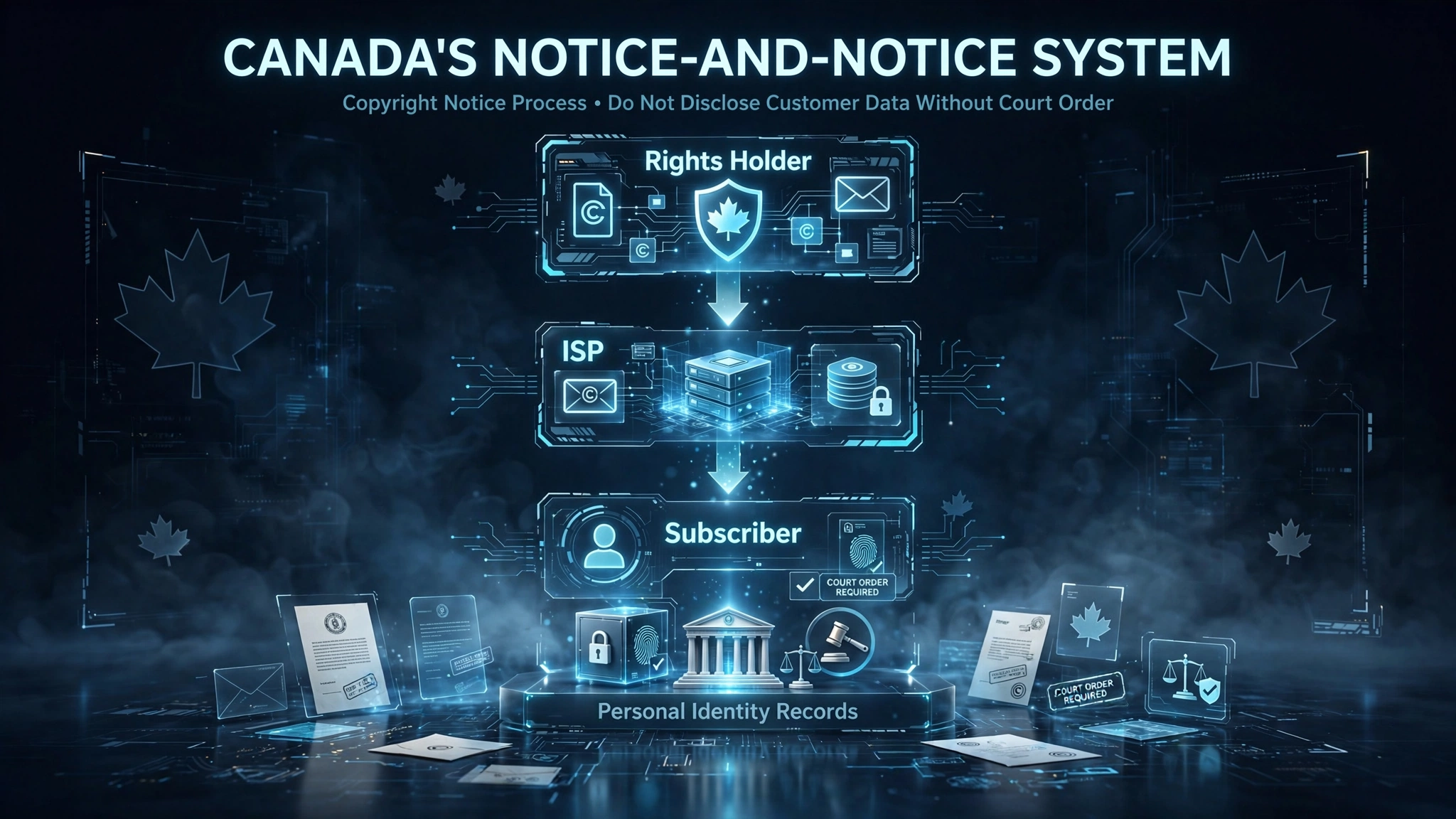
Canada operates a notice-and-notice system, and many people—including some of those who send notices—widely misunderstand it.
Under the regime, a copyright owner sends a notice to an ISP, and the ISP forwards it to the subscriber whose IP address was identified. Receiving a notice does not mean you have been found liable. It means an allegation has been forwarded to you. Only a court can rule that infringement occurred.
The regime imposes no obligation on you. It does not require you to contact the copyright owner or the intermediary, and a notice is separate from any lawsuit.
Your identity is not disclosed by default. The ISP is not required to hand over personal customer information. A copyright holder wanting subscriber details must obtain a court order. ISPs must retain records identifying notified subscribers for six months, extending to one year if the copyright owner commences proceedings and gives notice within that window.
Some notices are themselves invalid. Since December 2018, the Copyright Act has been explicit: a notice containing an offer to settle, a demand or request for payment or personal information, or a reference—including a hyperlink—to any such offer does not comply with the regime. Such notices are deemed invalid, and ISPs are under no obligation to forward them or to retain records for them.
If you receive a message that opens with a copyright allegation and closes with a payment link, that combination is precisely what the legislation prohibits. The full requirements are published by the Government of Canada’s Office of Consumer Affairs.
One practical point most guides omit: a notice identifies an internet connection, not a person. It may relate to activity by someone else using your network. Securing your connection with a strong password is a reasonable response to a notice you do not recognize.
Legal Ways to Watch TV in Canada
If the goal is lower cost without the legal question, several categories exist:
Licensed IPTV from major carriers—Bell Fibe TV, Rogers Ignite TV, and Telus Optik TV—are CRTC-authorized broadcasting distribution undertakings and are usually bundled with internet service.
Licensed independent distributors—smaller Canadian providers operating under the same authorization framework.
Free ad-supported streaming television (FAST) — legal, free, ad-funded linear channels built into most smart TVs and streaming devices.
Subscription video on demand—Netflix, Crave, Prime Video, Disney+, and similar services licensed for the Canadian market.
Over-the-air broadcast—a one-time antenna purchase gives free access to local channels in most populated areas, with no ongoing cost and no legal ambiguity.
Where these fall short: none of them solve the problem that drives most IPTV searches in the first place—international and community channels. A household wanting Arabic, Filipino, South Asian, or European programming will find licensed Canadian options thin, and that gap is the honest reason the unlicensed market exists. Recognizing it is more useful than pretending the licensed catalogue covers everyone.
For device and app compatibility across these options, see our comparisons of IPTV apps in Canada and IPTV devices in Canada.
Common Misconceptions About IPTV Legality
“IPTV means illegal.” It does not. It is a delivery protocol used by Canada’s largest licensed broadcasters.
“Using a Firestick makes IPTV illegal.” A Fire TV Stick is a general-purpose streaming device sold in retail stores across Canada. It runs Netflix, Crave, and YouTube. The hardware has no bearing on the licensing status of what is streamed through it.
“A VPN makes it legal.” It does not. A VPN affects network visibility, not the licensing status of the content being distributed. Whether a VPN serves any legitimate purpose for you is a separate question, covered in our guide on whether you need a VPN for IPTV.
“Cheap means illegal.” Price is a signal, not a rule. Licensed services also run promotions. The test is licensing, not cost.
“The app is illegal.” Player applications are neutral software, comparable to a web browser. They are neither the service nor the content distributor.
“If it’s blocked, using it is a crime.” A blocking order is a civil remedy directed at ISPs. It restricts access to specified addresses; it does not create criminal liability for subscribers.
Legal Note
This article is general information about Canadian law, not legal advice. Copyright enforcement, court orders, and blocking schedules change frequently—the July 2026 order described above superseded an earlier framework within weeks. For advice about a specific situation, consult a qualified Canadian lawyer. IPTV Concepts is an independent educational resource. We do not sell, host, or provide access to any IPTV service.
Bottom Line
So, is IPTV legal in Canada? Yes, the technology is. The decisive question is whether the provider holds the legal rights to distribute the content it carries. Three situations cover most readers:
If you are using Bell, Rogers, Telus, or another licensed carrier,there is no legal question to answer. You are using IPTV, lawfully, and have been all along.
If you are watching through an unlicensed service, your exposure is civil, capped at $5,000 in total for non-commercial infringement, and rarely pursued. What is far more likely than legal consequences is service disruption, as court-ordered blocking now expands faster than it used to. If you want to understand the licensing status of a service you are already paying for, start with our guide to what IPTV is and how legitimate distribution chains work.
If you are considering selling or reselling access—this scenario is the position Canadian enforcement actually targets. Statutory damages run to $20,000 per work with no cap, and the criminal provisions reach $1,000,000 and five years.
What is changing fastest is not the law but its enforcement machinery. The July 2026 order lets rights holders add domains to a blocklist without returning to court, which means the practical landscape now shifts on a timescale of weeks rather than years.